becoming unreal
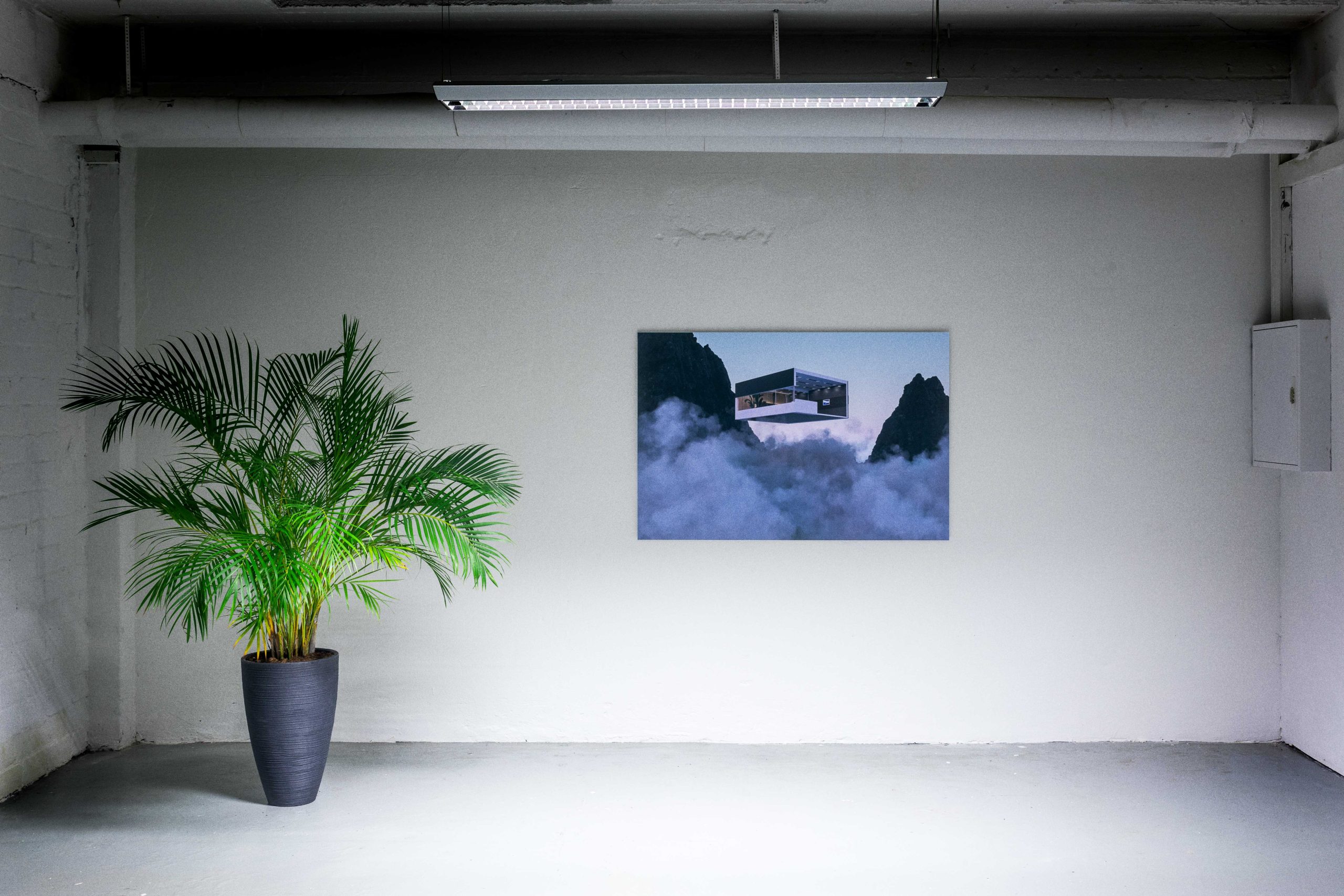
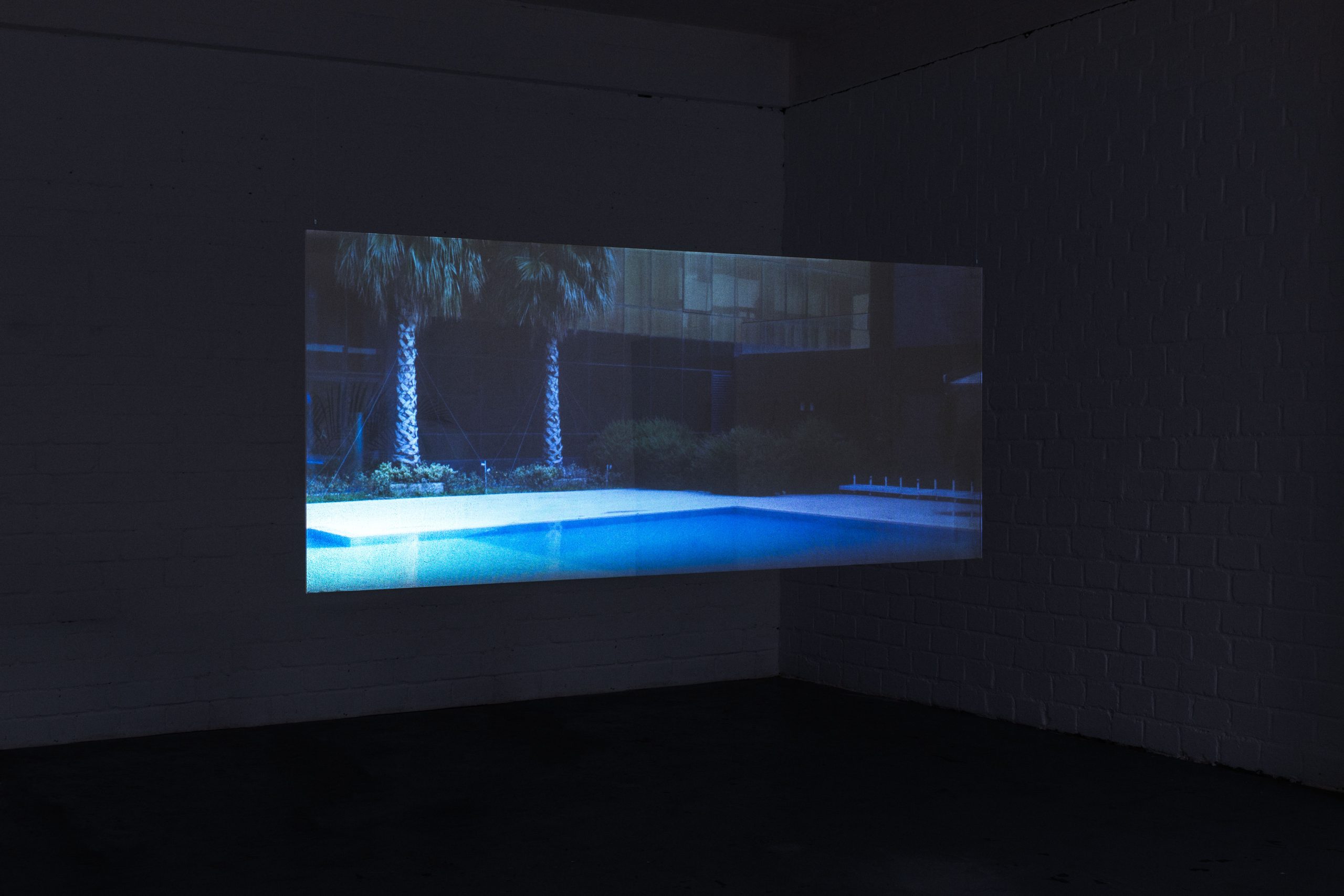
2022–2025, four-channel video installation, consisting of 4K video, variable length, colour, sound, Plexiglas, digital prints on Alu-Dibond, 150 × 100 cm, various media
becoming unreal is an ongoing cycle of works spanning a multi-channel video installation, digital prints, objects and a publication, concerned with the production of space under conditions of speculative finance. Its subject is the signature architecture of the global property market, airports, mosques, hotels and residential towers, commissioned as much for their recognisability as for their use and held as assets in a market that keeps them in permanent circulation. Filmed footage and spaces calculated in 3D software are matched so closely that the distinction between them dissolves, leaving interiors of an even, uninhabited perfection.
Lilian Haberer, art historian and curator, Professor of Art History with an Expanded Concept of Material at the Academy of Media Arts Cologne (KHM). Written on the occasion of the exhibition Becoming Unreal at Walzwerk Null, Düsseldorf, 2021, on the single-channel version.
“As global forms are articulated in specific situations—or territorialized in assemblages—they define new material, collective, and discursive relationships.”
Stephen J. Collier and Aihwa Ong, Global Assemblages, 2005
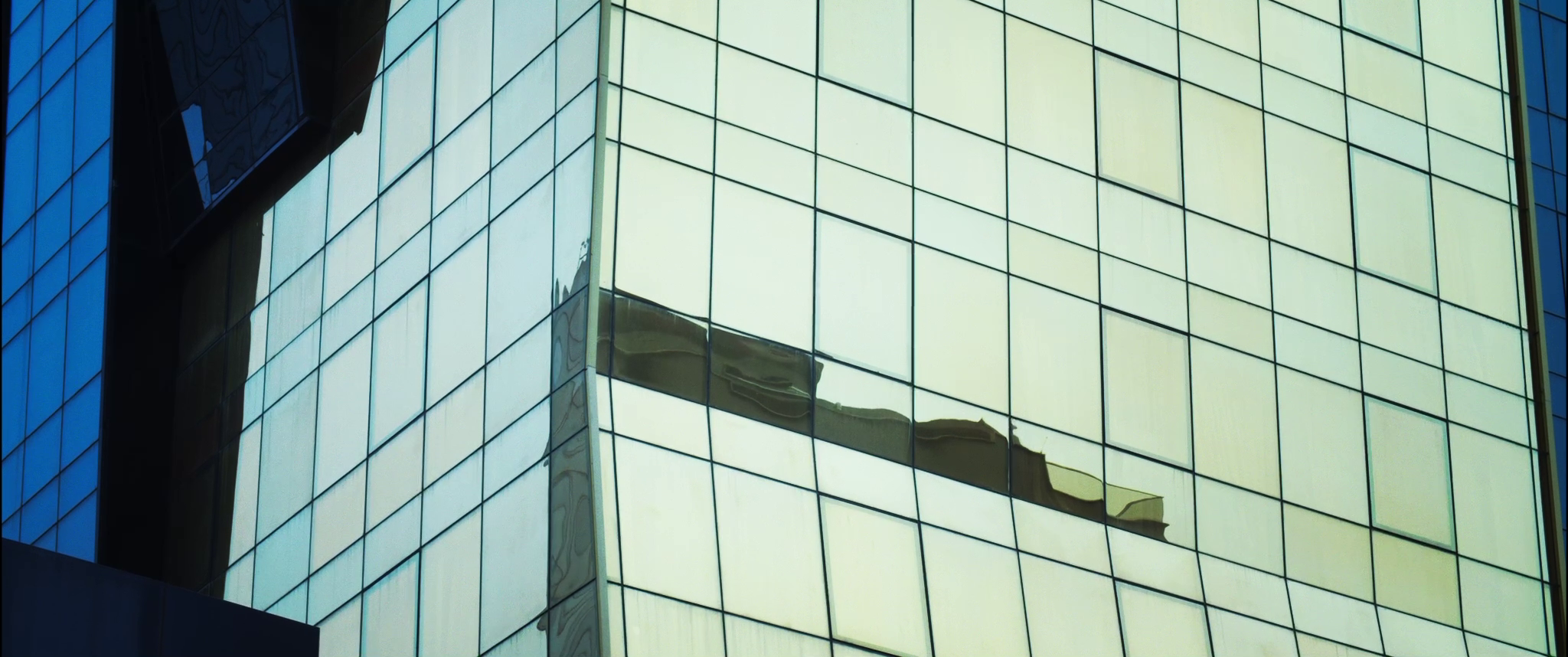
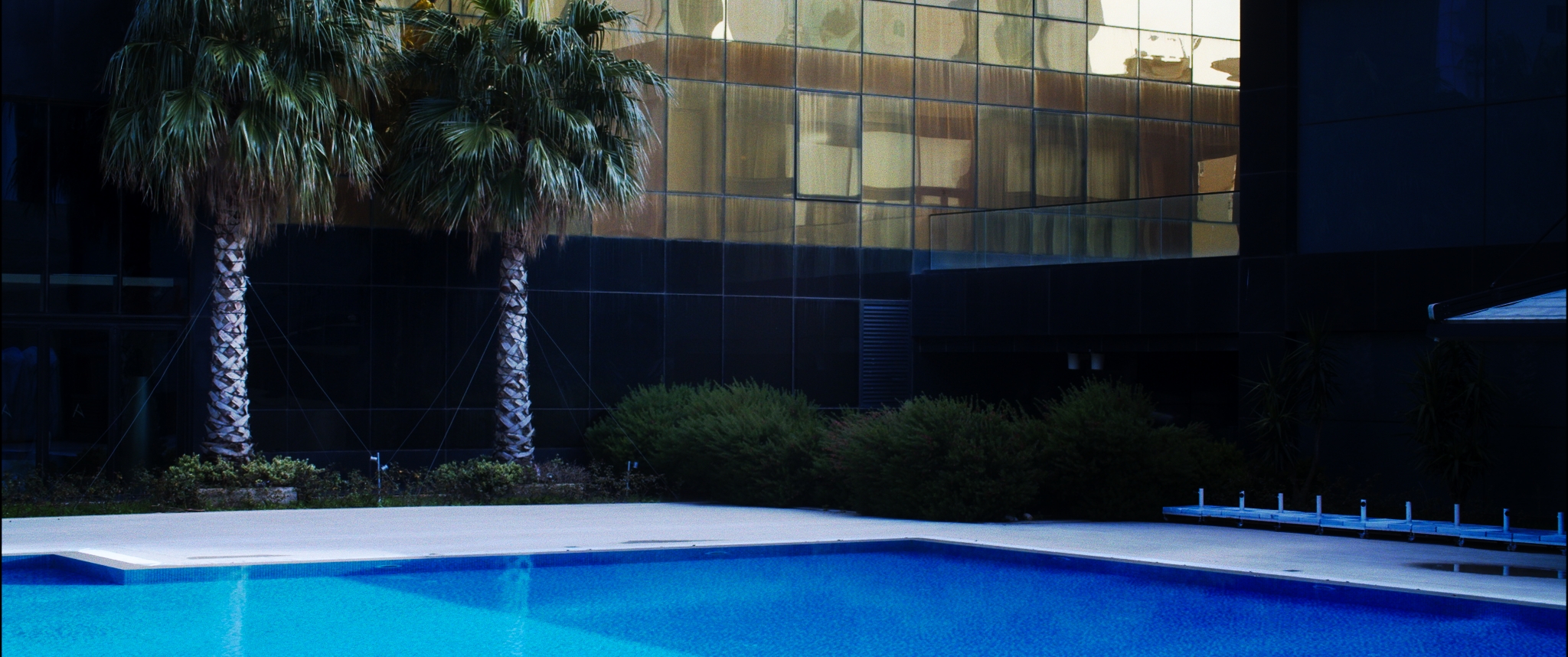
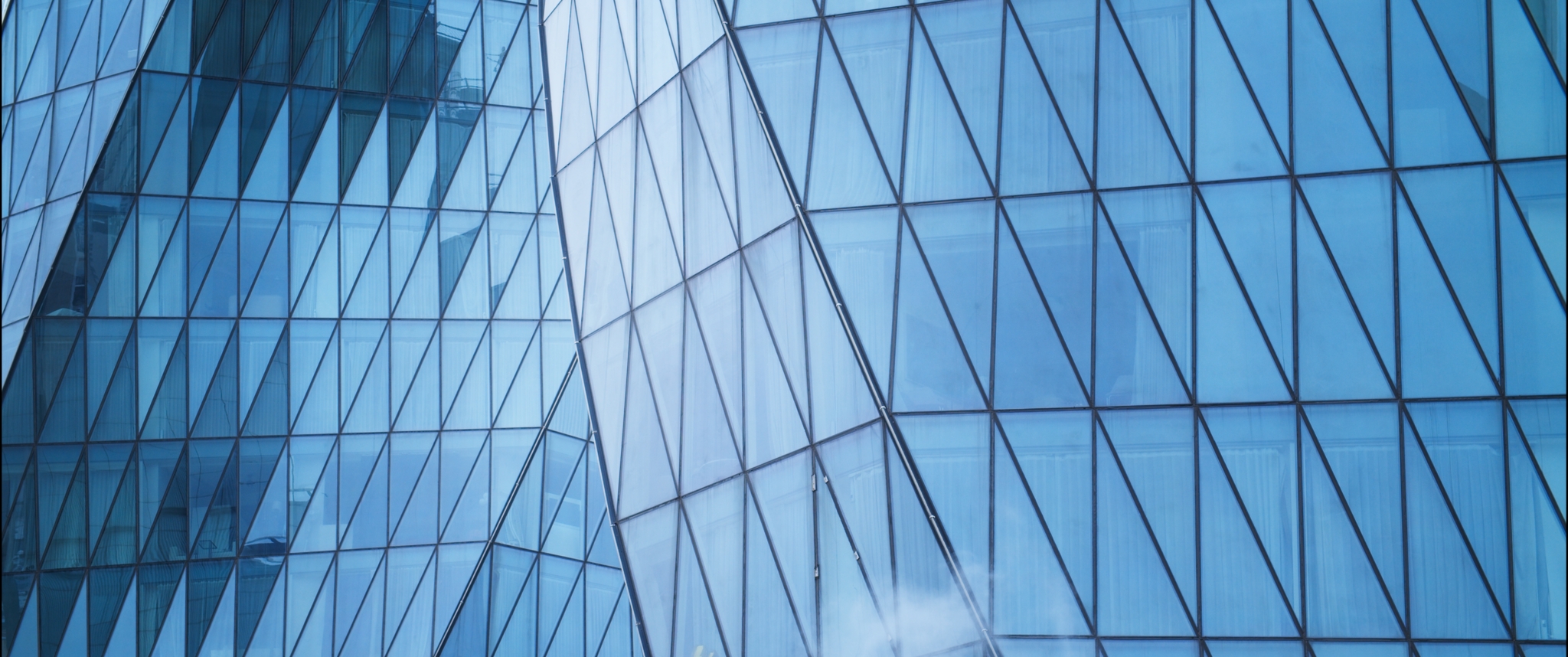
The twilit foyer opens onto a glass curtain wall with a geometric design that lets in the evening light. Another view through the space is provided by two reticulated and tapered windows that control the flow of air and light. Yet another view of the facade from the inside reveals narrow vertical bands of light with geometric ornamentation on the broadened side wings. In between are details of unique aspects of the architecture, which the camera slowly approaches. In longer shots, it pans over the interior and exterior surfaces of striking buildings. What they have in common is the absence of life. Devoid of people, silent and with an aura of sublimity, these scenes are captured by the camera. Only an almost imperceptible drone sound—slowly rising to a crescendo, becoming more bell-like and somber, conveying a quiet unease—accompanies the images, which change from distinctive interiors to the opaque, semi-transparent yet mirror-smooth facades of skyscrapers.
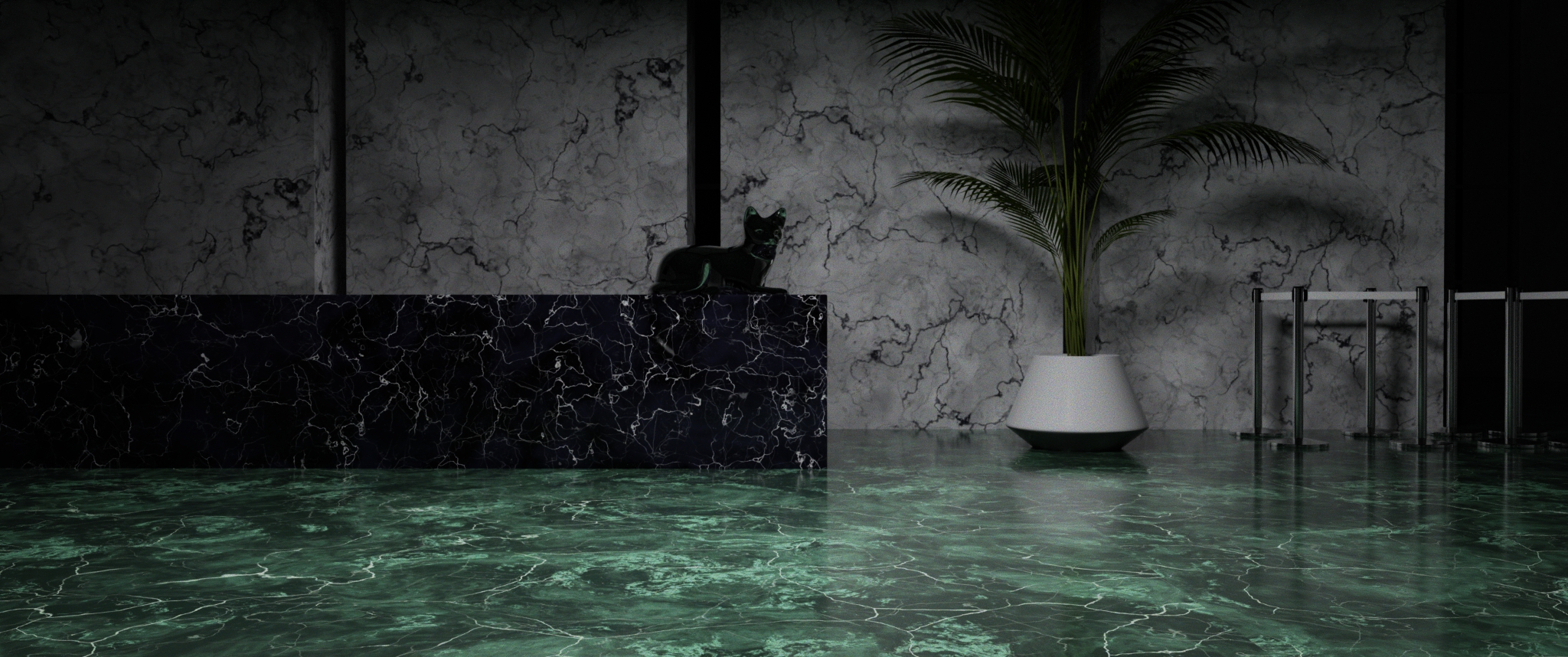
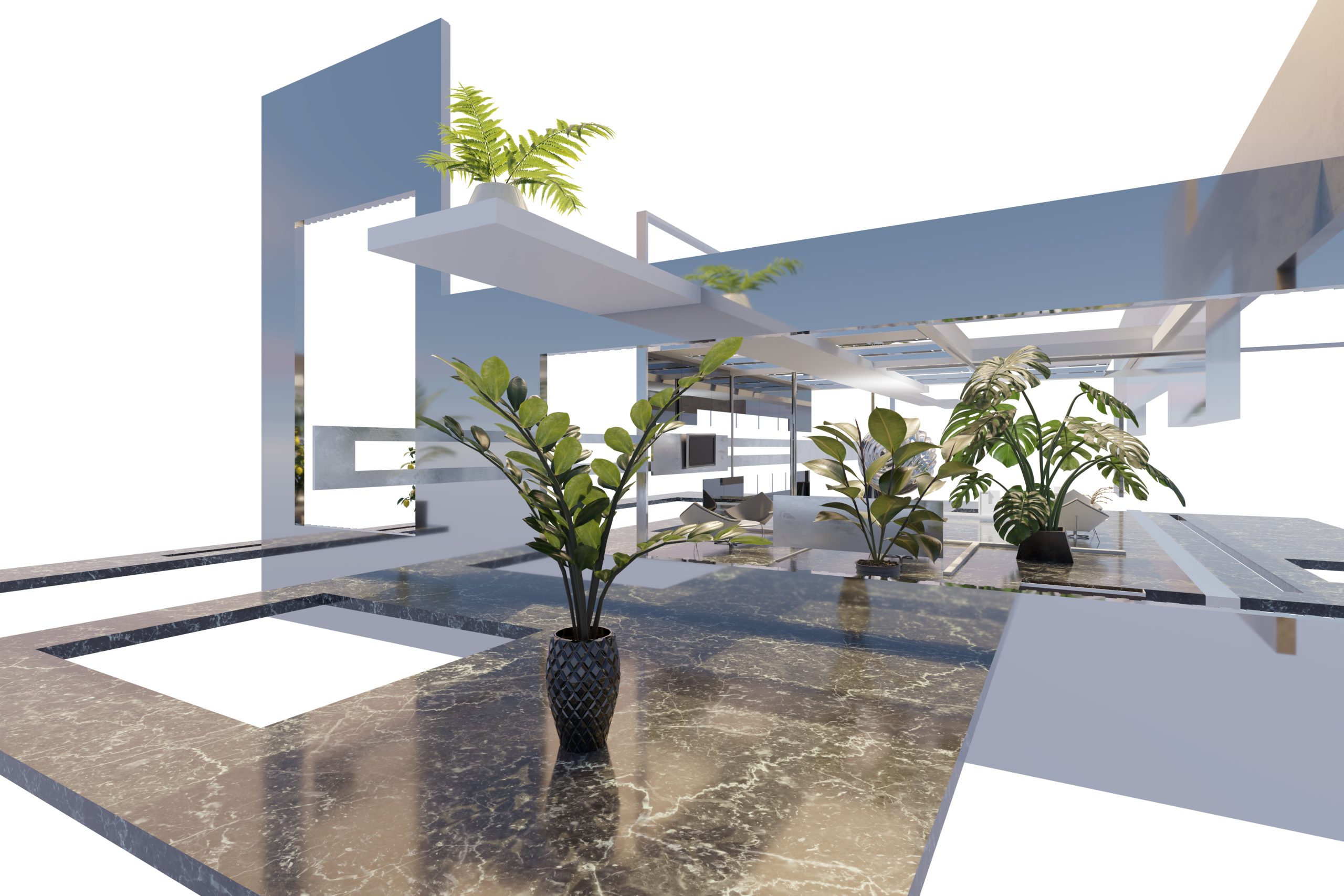
The first few minutes of Viktor Brim’s video work Becoming Unreal (2021), created during his residency in Istanbul, capture recent architectural and construction projects in the metropolis on the Bosporus, including modern mosques, the new Istanbul Airport, and hotel buildings. In the sequences that follow, it becomes apparent that real buildings are being alternated with digitally constructed spaces, and this perception creates moments of sudden change: for example, between the existing hotel corridor with a view of the city and the fabricated hotel room, complete with a television screen displaying high-rise projects as well as an animated video about escape routes in the event of an emergency. In the spacious foyer, with light screens in the wall paneling and recognizable surface textures—seemingly surreal in its built perfection—it is only the symmetrically arranged potted palms with clearly visible shadows and the incidence of light from an imaginary mountain landscape in the background that indicate that the room is a digital construct.
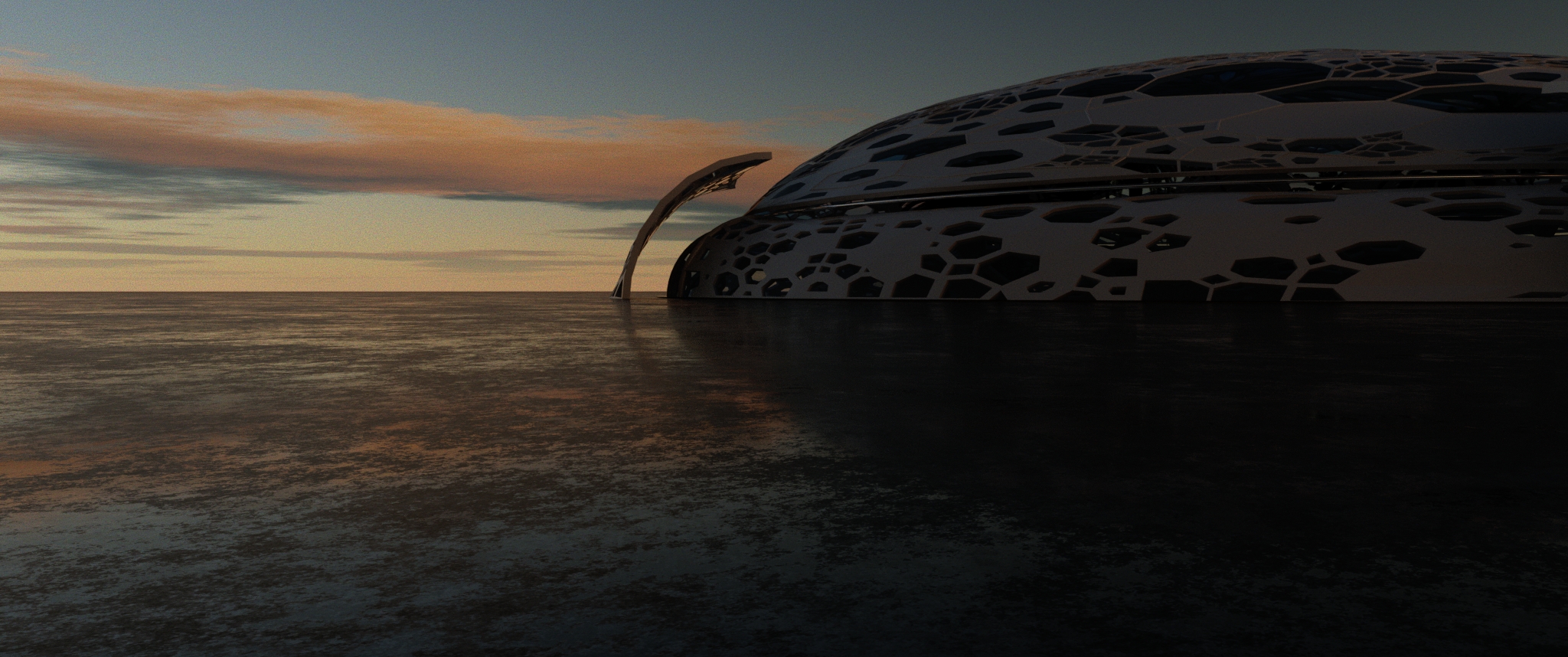
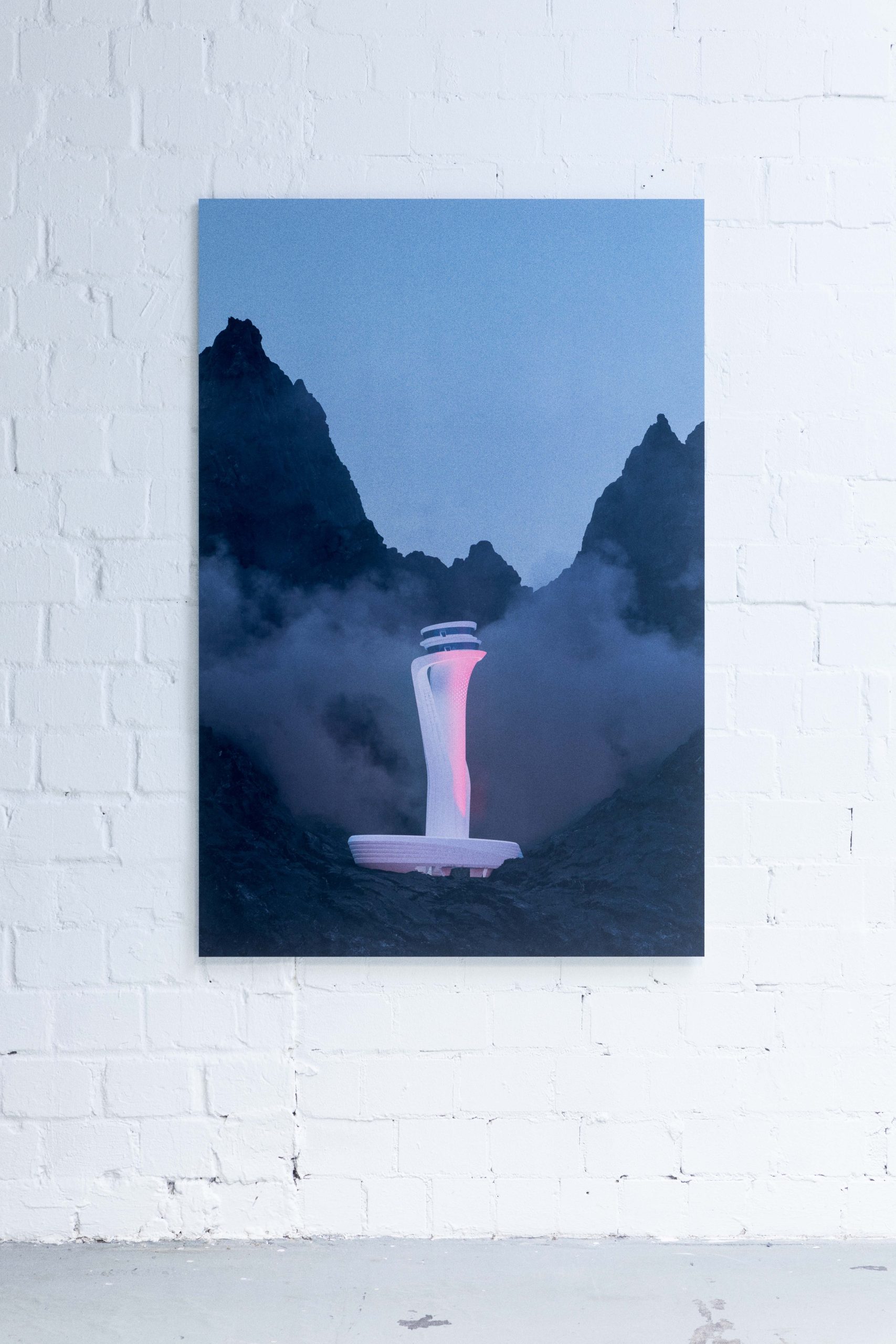
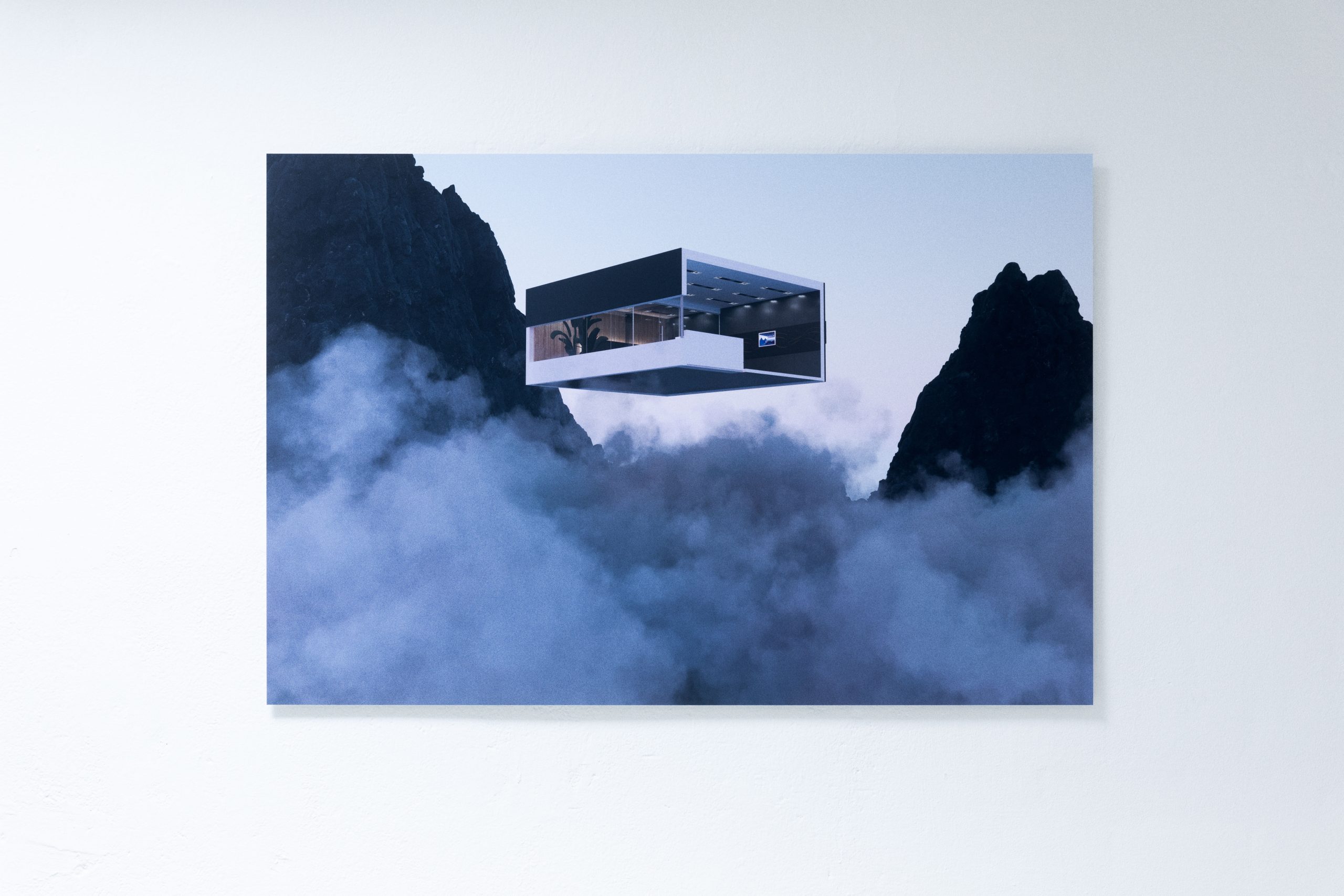
Futuristic ceiling details segue into modernist miniature architectural models that float in front of a mountain panorama with clouds and fog built in the software program Blender. As a landmark, the airport with its prominent beacon looks almost lost against the gloomy and dramatic mountain backdrop. Here, the models of new buildings drift into a hyperreal, abstracted world at lofty heights. The latter acts like a projection screen, forming the backdrop for these suspended structures presented as signature buildings. Viktor Brim works with the tilting of these designs into the hyperreal in a subtle yet striking manner, for his imagery experiments with the repetitive rhetoric and aesthetics of digital image films as well as modularized building scenarios. They focus on investments in new prestigious properties or speculative bubbles of entire neighborhoods, which transform and gentrify cities at great speed, primarily by increasing real estate prices and often neglecting social aspects. The artist is interested in the complex global economic and capitalist processes involved in this, as Collier and Ong have problematized with their study of assemblages as sites of technological, political, and value-adding change (Collier and Ong 2005). His project, as he recounts in a conversation, began with the megalomaniacal infrastructure project of Istanbul Airport, designed by Nicholas Grimshaw. This was tellingly dubbed a “mosque of mobility” (Meyer, FAZ, 2018), thus alluding to the neoliberal, hypercapitalist and indiscriminate nature of buildings: whether hotels or houses of worship, the only thing that matters here is recognizability created by form or ornamentation, as Viktor Brim succinctly articulates with Becoming Unreal by giving the impression of a visual essay.
In his analysis of late capitalism and postmodernism back in the 1980s, the Marxist philosopher Fredric Jameson examined these increasingly rapid processes of production and exploitation. He identified a close connection between aesthetic design, architecture, and economics, in so far as the mechanisms of allocation, expansion, and value creation in construction are progressively becoming part of a global economy that visibly and virtually generates transformation processes in built space (Jameson, New Left Review, 1984). As documented by the empty spaces, presented free of human intervention, this development moves away from the subject toward quasi “inconceivable hyperspaces” (Jameson 1984), increasing in both dimensions and abstraction, as they are presented in Brim’s digitally constructed architectural designs.
This is demonstrated in both the real and the futuristically animated images: the spherical form of an abandoned square with striking wall ornamentation in the evening light, or the floating dots of light from the ceiling fixture in the great hall of an imposing mosque with arched windows eventually transition from an enigmatic space with a white, shuttered portal to a serpentine, mirror-smooth honeycomb structure that opens onto a piazza. Its perforated, white domed roof reveals refractions of light with a uniformly blue sky and is faintly reminiscent of Jean Nouvel’s multi-billion Louvre Abu Dhabi project, with its layered structural steel dome and design using premium materials and techniques. Investment in such an architectural project functions as an asset, and as the sociologist Saskia Sassen has pointed out, it transforms the city, as many of these acquisitions can be used for speculation. The value of these buildings, as well as the digital technologies associated with them, are stimulating and transforming the global financial flows that exist independently of their local contexts (Sassen, TATuP, 2021).
Viktor Brim is concerned with this exact Global Financial Centers Index, which rates similar large-scale infrastructural projects according to certain criteria that allow cities to become global market leaders. Not only does his video work Becoming Unreal visually and emphatically demonstrate this complex and rapid transformation into something intangible and unreal, he also expands it into a spatial installation. At Walzwerk Null, the video is projected onto a free-floating pane of glass, while two photographic works on the opposite end wall and side wall each portray the model views shown in the film. The potted plant from the digitally constructed virtual environment casts its shadow into the exhibition space and simultaneously raises the question of where we as viewers are situated: Are we not already in the middle of this hybrid urban reality?
Vanina Saracino, independent curator and writer, Adjunct Professor of Experimental Film and Media Art at the Universität der Künste (UdK), Berlin. Written for VIDEONALE.20, Kunstmuseum Bonn, 2025, on the multi-channel installation.
Becoming Unreal is an open-ended body of work encompassing a multi-channel video installation, digital prints, a collection of objects, and a publication, all aimed at exposing the social, economic, and political fractures beneath the pristine facade of signature mega-architectural projects. The work delves into the intricate power dynamics of real estate and speculative finance, inspired by the concept of liquid contemporaneity—a condition of perpetual flux and uncertainty that mirrors the shifting landscapes of modern urbanism and the volatile nature of global markets.
The camera movement—crafted through polished CGI and deliberately artificial imagery—mirrors this fluidity, floating ghost-like across mega-architectures of Istanbul, such as modern mosques, the new airport, and hotels, all devoid of human presence. Their emptiness and apparent uninhabitability prompt us to question the relationship between these structures and the human bodies meant to occupy them. The work addresses the stark inequalities of the global property market and the invisible labor behind such mega-projects; the creation of these buildings is often marked by ›streamlined operations‹ designed to boost efficiency—automating tasks and reorganizing workflows—ultimately at the expense of the human bodies that bear the costs of this production. Becoming Unreal raises critical questions about the role of technology—represented by the 3D rendering aesthetic that defines the work—in shaping our perception of urban spaces and about the experiences of those who navigate those spaces. Ultimately, the work urges us to reconsider our relationship with architecture and the broader socio-economic structures that underpin it.
The work opens on Istanbul Airport. It stands on the Black Sea coast, about 35 kilometres north of the city, on a site masterplanned by the engineers Arup. The terminal was designed by the offices Grimshaw, Nordic Office of Architecture and Haptic Architects and built by a consortium of five Turkish construction firms, Cengiz, Kolin, Limak, MAPA and Kalyon, under a concession to Istanbul Grand Airport, or IGA. Its first phase opened in 2018. With a floor area close to 1 million square metres, it was announced as the largest airport terminal in the world under one roof, built for 90 million passengers a year and, fully complete, more than 150 million (ArchDaily; Grimshaw). In the film the airport appears empty and still, less a place to pass through than a monument.
Recent Istanbul mosques run through the film, with wide halls and arched windows. In the press the new airport was itself dubbed a mosque of mobility (Meyer, FAZ, 2018): once buildings are made mainly to be recognised, little separates a terminal, a hotel and a house of worship. The building of grand mosques under the governing party has been described as entrepreneurial religion, in which faith, state and property develop together and the mosque works at once as devotion and as landmark (Lanz 2016). The film treats these buildings the way it treats the airport and the hotels, at the same even distance, so that their shared surface, not their function, comes forward.
The film moves through Istanbul hotels, along corridors that look out over the city, and then into a hotel room that was never filmed. On its television screen play high-rise projects and an animated safety video about escape routes. Elsewhere a wide foyer looks real until symmetrical potted palms throw clean shadows and an imaginary mountain range appears behind the glass. The cut between the filmed corridor and the built room keeps every surface at a single finish, so the eye keeps sliding from what is there to what has only been calculated. None of these rooms is scaled to a single person. Writing in the 1980s, the critic Fredric Jameson described a built world drifting toward vast, abstract hyperspaces that no one standing inside them can hold in view.
Many spaces in the film are not filmed at all but built in Blender. Signature buildings float as small models in front of a mountain panorama of cloud and fog, and the airport’s beacon looks almost lost against it. The rendered models stand free of any street, ground or neighbour, buildings reduced to their outline. Lighting, texture and reflection are pushed until the rendered surface carries the same weight as the photographed one. When a copy reaches this point, where it no longer refers to any original, it has crossed into what Jean Baudrillard called the hyperreal, the copy that has replaced the thing (Baudrillard, Simulacra and Simulation, 1981).
The property industry sells towers before they are built. Its image films and walk-throughs, the polished animations made to move a tower before a single stone is laid, show a building that does not yet exist. Ivan Chtcheglov gave this drive a refrain in 1953: the hacienda must be built, and its twist, you will never see the hacienda, it doesn’t exist (Chtcheglov, Formulary for a New Urbanism). Two years later Guy Debord took a line from André Breton: the imaginary is that which tends to become real (Debord, Introduction to a Critique of Urban Geography, 1955). The rendered rooms of the film, calculated in 3D software rather than filmed, are that imaginary tower on its way to becoming real, and the work lets them tip over into the plainly unreal.
Liquid contemporaneity is the condition the curator Vanina Saracino names for the work: a present in which little keeps a solid form for long. The figure of a liquid present goes back to the sociologist Zygmunt Bauman, who described how the steady structures of modern life, long jobs, fixed institutions, lasting bonds, melt into arrangements that keep changing, while capital travels light and power lies with whoever can move fastest (Bauman, Liquid Modernity, 2000). The money behind Istanbul’s towers lives in this state. It passes through shell companies and low-tax jurisdictions in days, buys flats it will never inhabit and can leave as quickly as it came. The buildings are its temporary solid form, concrete poured around liquid value.
The Global Financial Centres Index, published with the Qatar Financial Centre among others, is a ranking that scores cities on their workforce, legal setup, market access and investment climate, and helps steer where global capital goes. Istanbul has been building on an enormous scale partly to climb it. The city has appeared in the index since 2009, tied to a state plan for an Istanbul International Financial Center, and it has courted Islamic finance and Gulf capital in particular, a market worth well over a trillion dollars (World’s New Financial Hub: Istanbul). To rise in such a ranking a city must turn as much of itself as possible into something investable. That turning of land, buildings and services into tradable value is called financialisation, and the airport and the towers in the film are its instruments.
Istanbul’s new towers and terminals sit inside what is called the FIRE economy, short for finance, insurance and real estate: the tightly linked world of banks, insurers, mortgage brokers, developers and funds that now decides how buildings and whole districts are planned, owned and used (Soules 2021). Insurers are among the largest property investors in the world. The geographer David Harvey describes the motor behind it: capitalism keeps producing more money than it can profitably reinvest, and endless building is one of the main ways this surplus is absorbed (Harvey, via Soules 2021). Architecture becomes a main medium of financialisation, the turning of land and buildings into tradable value. For most households a home is the largest asset and the easiest to borrow against, and housing has become a global asset class whose prices rise and fall in step across the planet (Soules 2021).
The towers and terminals the film moves through belong to a type: the signature building, the landmark commissioned less for its use than for its image and its power to draw investment. The type is old. In 1962 Eero Saarinen’s TWA Flight Center opened at New York’s Idlewild airport, a terminal shaped like a bird about to fly and sold through a large press campaign; it was obsolete for jumbo jets almost from the first day and stood empty for decades, only its form survived (Ringli 2015). The Guggenheim in Bilbao, 1997, gave the type its slogan, the Bilbao effect, the belief that one spectacular building can transform a city (del Cerro Santamaría). The airport in the film belongs to the same line, where the image is built to outlast the function.
Behind the polished facades of luxury real estate runs a global network of financial service providers. Their clients at the top of the market are what the consultancy Capgemini labels ultra high net worth individuals, people with at least thirty million dollars to invest; by the firm’s own figures the large majority are white men over fifty. Owning property is one of the main ways such wealth spreads across cities. The chain that makes this possible, the corporate, trust and fund administrators, offers real estate holding, ship and aircraft ownership and special purpose vehicles, and moves companies between low-tax places such as the British Virgin Islands, the Cayman Islands, Panama, Delaware and Dubai (Trident Trust). Its central promise is secrecy: shell companies keep the owner out of view, lifted clear of tax, disclosure and public interest.
The Situationists, the postwar group around Guy Debord, described the very rich traveller before the term existed. Power, they wrote, shows itself as the need to be present each day at more and more places further and further apart, so that a VIP could be defined as someone who has appeared in three different capitals in the course of a single day. You don’t live somewhere in the city, you live somewhere in the hierarchy (Basic Program of the Bureau of Unitary Urbanism, 1961). The owner with thirty million dollars to invest lives at that altitude, and the airport is the machine that keeps them moving. In the film this traveller never appears; only the spaces built for them do.
When a building is mainly an asset, it does not need anyone inside it. An empty, furnished flat holds value as well as an occupied one. Manhattan’s Billionaires’ Row, the line of ultra-thin luxury towers along Central Park, is the clearest case: apartments bought through shell companies and trusts as safe deposit boxes for parking money, so that in several of the buildings around half the units sit empty (Billionaires’ Row, English Wikipedia). The architect Matthew Soules calls this zombie urbanism, a tower that serves as a tax shelter or a short-term bet and drains the street life around it (Soules 2021). Situationist writing of the 1960s wanted the opposite emptiness, an absence of occupation where a freer life could begin (Basic Program of the Bureau of Unitary Urbanism, 1961). The empty flat is that void inverted, a store of value where nothing will ever happen.
Istanbul’s building boom empties older neighbourhoods of the people who live there. Since the 1980s the mass-housing agency TOKI, and a 2005 law on renewing run-down historic areas, gave the state and city wide powers to clear and rebuild (Enlil 2011). Sulukule, a centuries-old Roma quarter, was demolished despite protest. In the Fener and Balat renewal on the Golden Horn, about 70 per cent of the buildings were slated for demolition and some 900 families were to be moved (del Cerro Santamaría). Tarlabaşı was cleared for luxury redevelopment. Renewal is announced for the residents and carried out without them, what the Situationists called false participation (Basic Program of the Bureau of Unitary Urbanism, 1961). Against it a movement claims a right to the city, a say in the ground itself (Enlil 2011). The film keeps these people off screen, present only as the absence the empty rooms are built around.
Istanbul’s new buildings rest on bodies that do not appear in their images. Istanbul Airport was built by some 35,000 to 40,000 workers. By official figures at least 52 died in accidents on the site between 2013 and 2018, while a newspaper report alleged that up to 400 deaths had been played down (Amnesty 2018; Reuters 2018). In September 2018 thousands of workers protested over unpaid wages, safety and vermin-ridden dormitories; police detained around 500, most of them Kurdish, in a night raid, under the slogan we are not slaves (HRW 2018; Amnesty 2018). President Erdoğan opened the airport six weeks later. This is the labour the curator Vanina Saracino calls invisible, the streamlined operations whose costs are carried by the people who build. The film’s smooth, empty surfaces are the other side of it.
On the soundtrack two kinds of spoken text take turns. The first are monologues in the offshore providers’ own voice, written from the marketing language of law firms, trust offices and wealth managers: banking excellence, regulatory compliance, tailored solutions for a global clientele. The register is that of the real firms named in the Pandora Papers, the 2021 leak of offshore files, whose public answers ran to the same words, strict compliance, full confidentiality, and no further comment (Pandora Papers, ICIJ 2021). The voice is smooth, lawful and empty of any person, the audible match of the empty rooms. It promises order and discretion while naming no one, the other half of Debord’s line that that which tends to remain unreal is empty babble.
On the soundtrack, texts by the Situationists, the postwar group around Guy Debord that attacked the city of consumption, answer the offshore monologues. Three of their texts are heard. From Debord’s Society of the Spectacle comes the chapter on territory: capitalist production flattens space into something interchangeable, makes every place banal, and turns urbanism into capital’s seizure of the human environment. The Basic Program of the Bureau of Unitary Urbanism (Kotányi and Vaneigem, 1961) reads planning as conditioning and names détournement, the turning of existing material against itself, as the answer. Raoul Vaneigem adds that the factory is now everywhere, that paid work has spread into the whole of daily life (Vaneigem, From Wildcat Strike to Total Self-Management, 1974).
Two Situationist texts from the 1950s read the city on foot. Debord’s Introduction to a Critique of Urban Geography (1955) set out psychogeography, the study of how a place, its streets and atmospheres, works on feeling and behaviour. Ivan Chtcheglov’s Formulary for a New Urbanism (1953) made drifting through the city its main activity and called for buildings that can be altered at the will of the people living in them. Chtcheglov opens with a line that still fits the rendered foyer: we are bored in the city. One vocabulary reads the city as a portfolio, scored for investment and arranged to be owned; the other reads it as a place felt, walked and altered from below. Détournement, the turning of existing material against itself, is also the method of the work: it takes the property industry’s walk-throughs and the offshore providers’ words and turns their rhythms inside out.
becoming unreal began during a residency at the Atelier Galata in Istanbul in 2021, a residency of the City of Cologne in the Beyoğlu district. The production was supported by the City of Cologne and Filmlab Düsseldorf. A first, single-channel version was shown at Walzwerknull, Düsseldorf, in 2021, projected onto a free-floating pane of glass with accompanying prints. The multi-channel installation was presented at VIDEONALE.20 at the Kunstmuseum Bonn, 11 April to 18 May 2025.