imperial objects

2020, artist’s book, 132 pages, 24 × 17 cm, thread-stitched hardcover, limited edition of 20 copies

imperial objects is a book about the Republic of Sakha (Yakutia) in eastern Siberia and one of the two parts of the site-specific installation imperial machine; the other is the film dark matter, made in the same diamond field. It gathers photographs, spoken memories, local rumours and found paper collected there between 2017 and 2018. Its starting point is the Mir diamond mine at Mirny and the state projects that followed it, among them the twelve nuclear devices set off underground across Sakha between 1974 and 1987. Most of this work was secret, so what people remember is often the only account beside the paper the state prints about itself. The book holds both, in three chapters printed in three colours.

The book has three parts, each on its own ground: imperial landscape on white, imperial narrative on blue, imperial present on red, the three colours of the Russian flag in that order. Each chapter of the book sets four kinds of material side by side at the size of the page: photographs made on site, transcribed testimony, circulating rumours, and copies of found documents, from a fridge magnet to a company newspaper. A plutonium reading, a magnet slogan, a UFO seen from a boat and a press release all get the same space, and there are no captions, so the page never says which item is evidence and which is hearsay. The spoken testimony runs through all three chapters as white type on black. It is the only first-person voice in the book. The book opens and closes on sheets of a Soviet military map of the region, the first sheet centred on Udachny, contour lines and grid squares laid over the ground the pages walk through.

The word imperial in the three chapter titles names a way of running territory. In the last decades before 1917 the tsarist state built a whole expert language for it, with its own handbooks, institutions and journals: colonisation, kolonizatsiia, meant the planned transformation of territory, set apart from pereselenie, the spontaneous resettlement of people, and a semi-official handbook of 1914 could call Asiatic Russia both an inseparable part of the state and its only colony (Masoero 2013). The word colony itself stayed suspect, because in the European experience colonies had broken away, and an autocracy built on territorial integrity preferred to speak of peripheries and possessions (Masoero 2013). The Soviet Union kept the direction and changed the instruments; the mines, towns and tests the book collects are the work of those instruments in Sakha. In today’s Russian Federation the region is filed as a federal subject, a legal term that ranks territories by their degree of autonomy. The three chapters follow what this order has set into the ground.

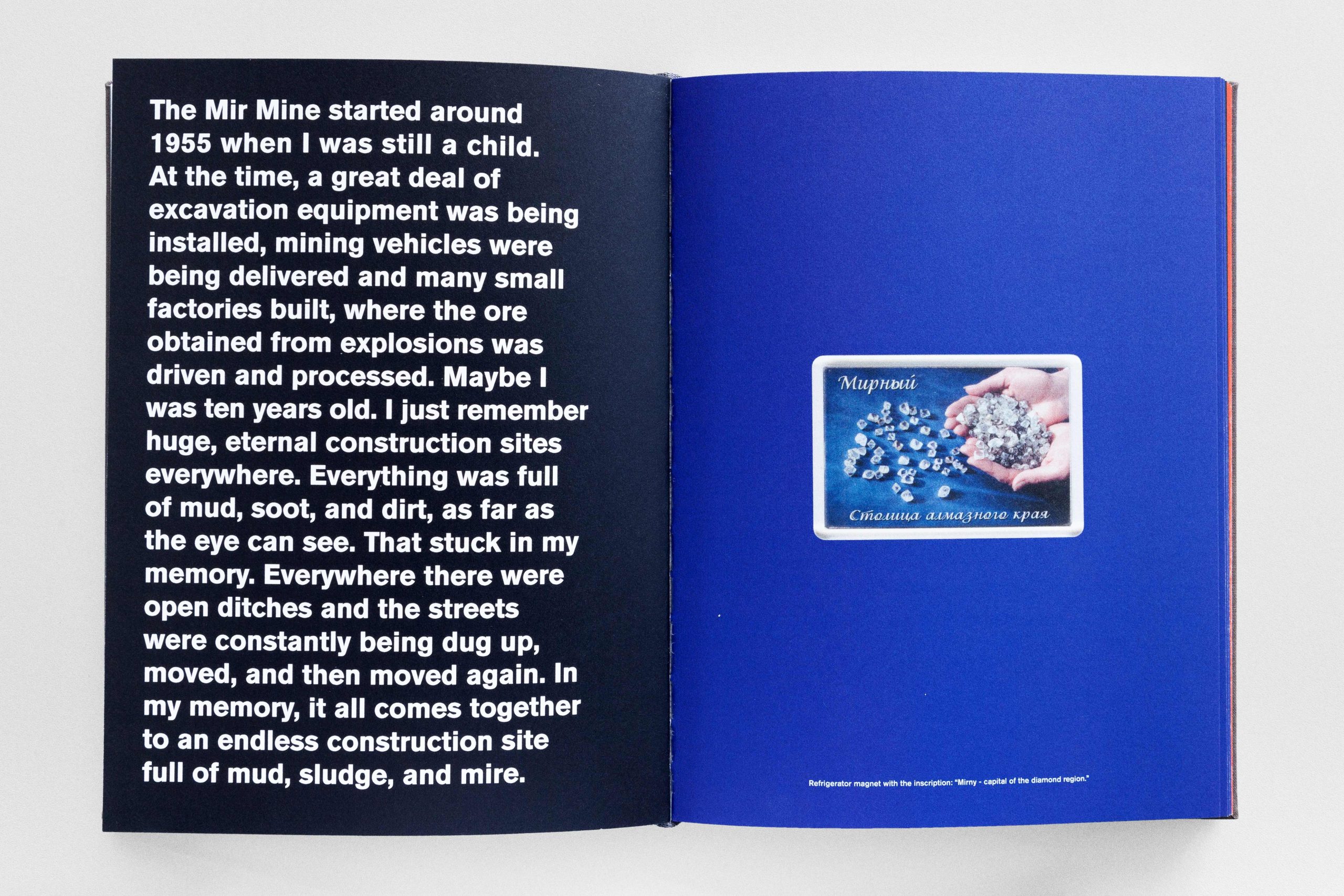
The spoken passages in the book come from interviews with Alexander Jegorovich, who spent his working life in the diamond districts; they were recorded in Russian and reach the page through German. He arrives at the excavations at Mirny in the 1960s, when there is no town: a year in a tent against minus 60 °C, then a state-assigned hut without roof or floor, its bricks knocked out of a disused power station. Near the village of Krestyakh the lingonberry bushes flower a second time and change colour, and the blast is read off the plants before any announcement arrives. A boy climbs onto a floating dredger, a machine that digs and washes river gravel for diamonds, to bring his father lunch; today guards watch the machines around the clock. The reservoir on the Vilyui, the river dammed to power the mines, softens the winters: bird cherry appears where it never grew, and where snow and minus 40 once arrived by early November, it can stay mild until New Year. The cold still splits trees at minus 66 °C and peels the tread off iced tyres like snakeskin.

Crystal is the name of one of the underground nuclear tests in the book. The tests were ordered by the USSR Ministry for Metallurgy to speed up mining and construction by blasting open the rock, and they were kept so secret that even the leadership of the Yakut republic did not know of them. Crystal was fired 2.5 kilometres north of Udachny in 1974 with a yield of 1.7 kilotons, planned as the first of eight shots whose craters were to hold the waste of a diamond processing plant; the radioactive remains came back to the surface, and the rest of the series was cancelled. In the samples of 1993, the account in the book continues, scientists of the Radium Institute in St Petersburg found the plutonium in the rock at twenty times the normal level. From the day of the first detonation, the forest around the site divided into dead and living forest, and in forest fires the smoke of the contaminated leaves carried the radioactivity kilometres high into the air.

Through the book runs a set of rumour passages, the lore around the test sites, and next to them the book sets explanations. On the upper Vilyui lies a place called Yeluyu Cherkechekh, roughly Valley of Death, where a flattened metal arch with many inner chambers is said to stay warm through the hardest frost, and hunters who slept there are said to have sickened and died. On a June night a miner, his son and a hunter see an orange sphere fifty metres across burning on the bank and push off downstream as the taiga lights up. Most of the mysterious metal in the taiga carries the label of a Soviet works. Spent rocket stages from the Baikonur launch site in Kazakhstan come down along fixed corridors and collect on the ground. A whole village in the Altai mountains is said to have built ovens out of the jets of fallen stages, and a radionuclide battery, a power unit that runs on radioactive decay and never cools, is said to keep a wild-boar shelter of spruce branches warm through the Siberian winter. Rumour and explanation are told in the same voice.

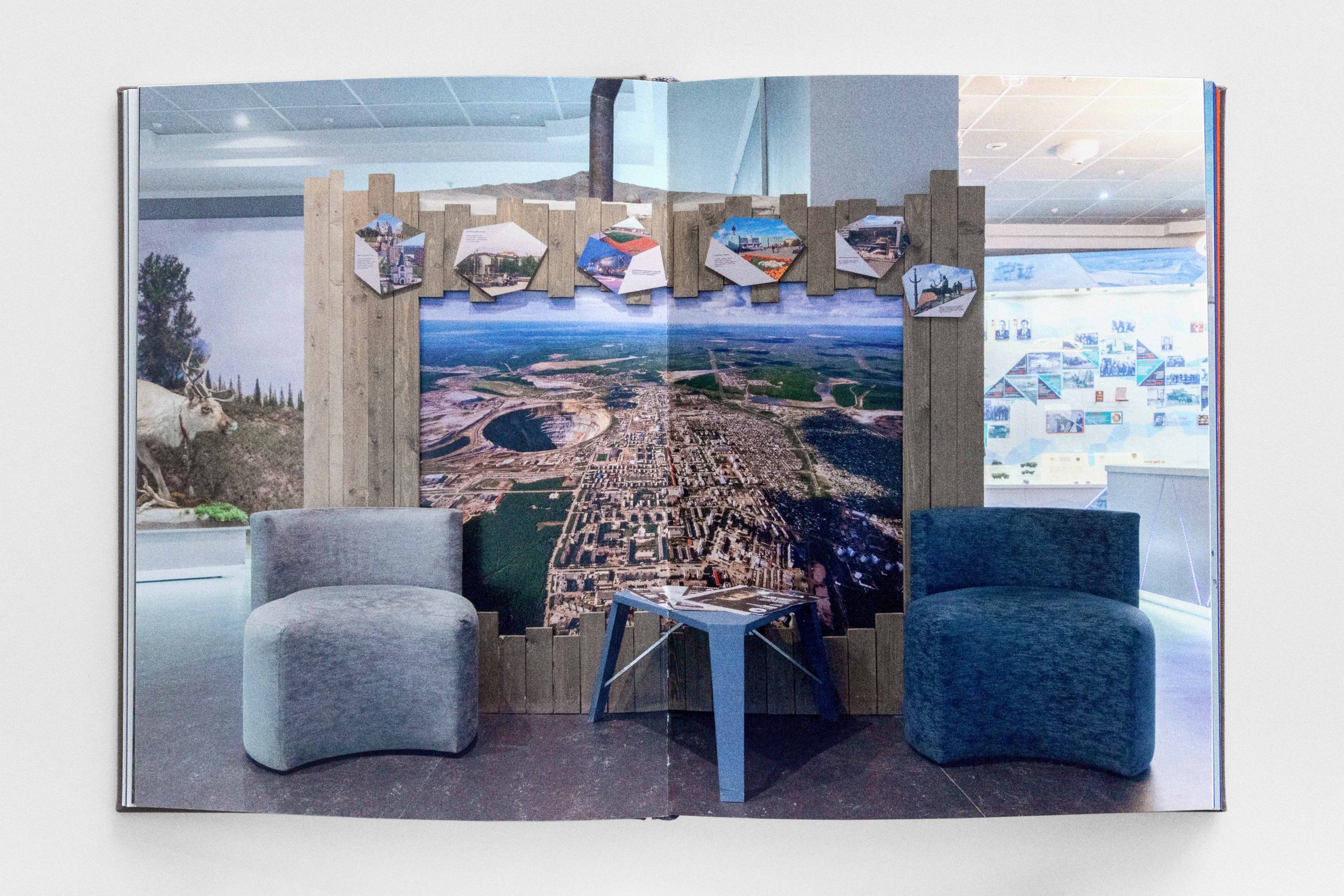
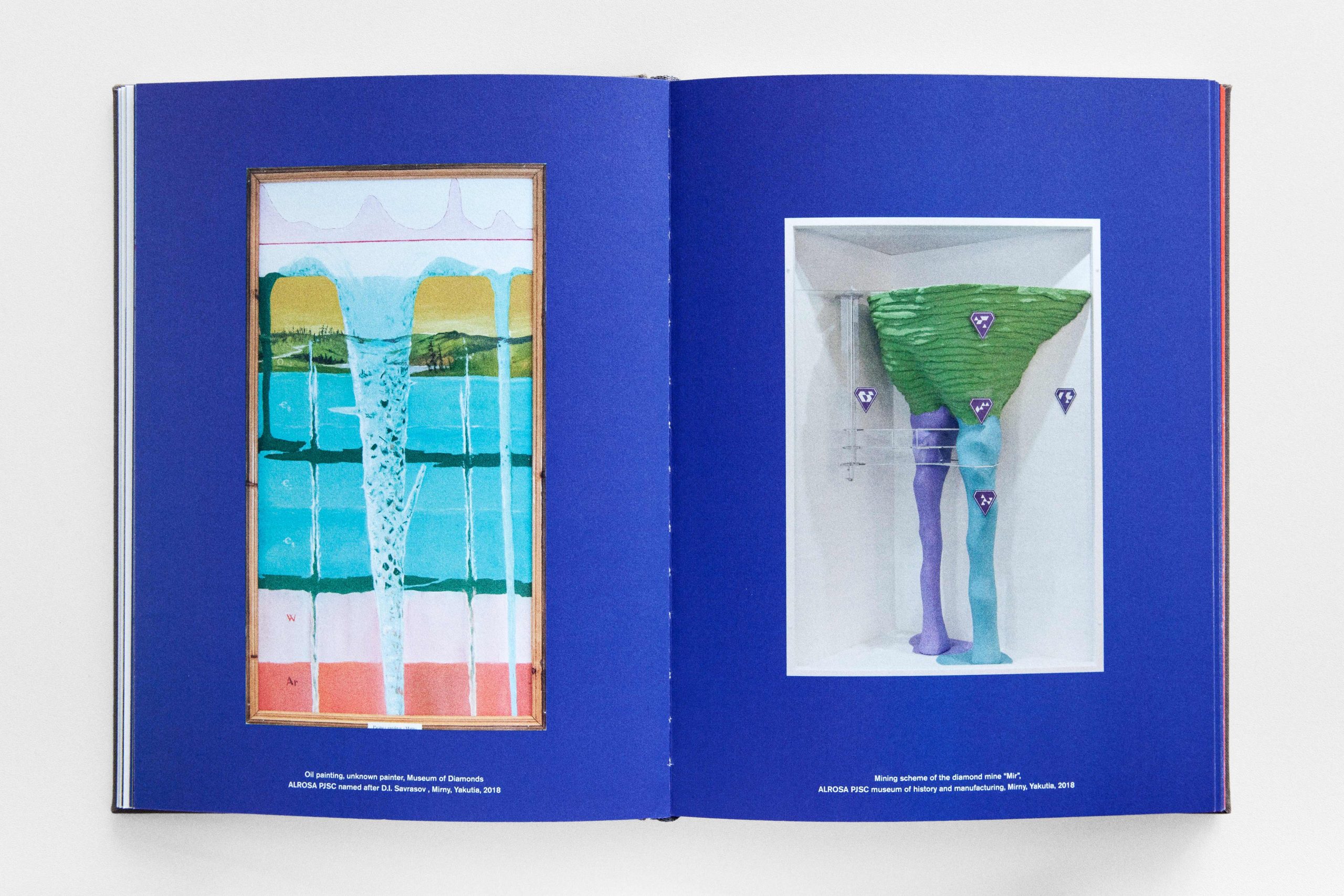
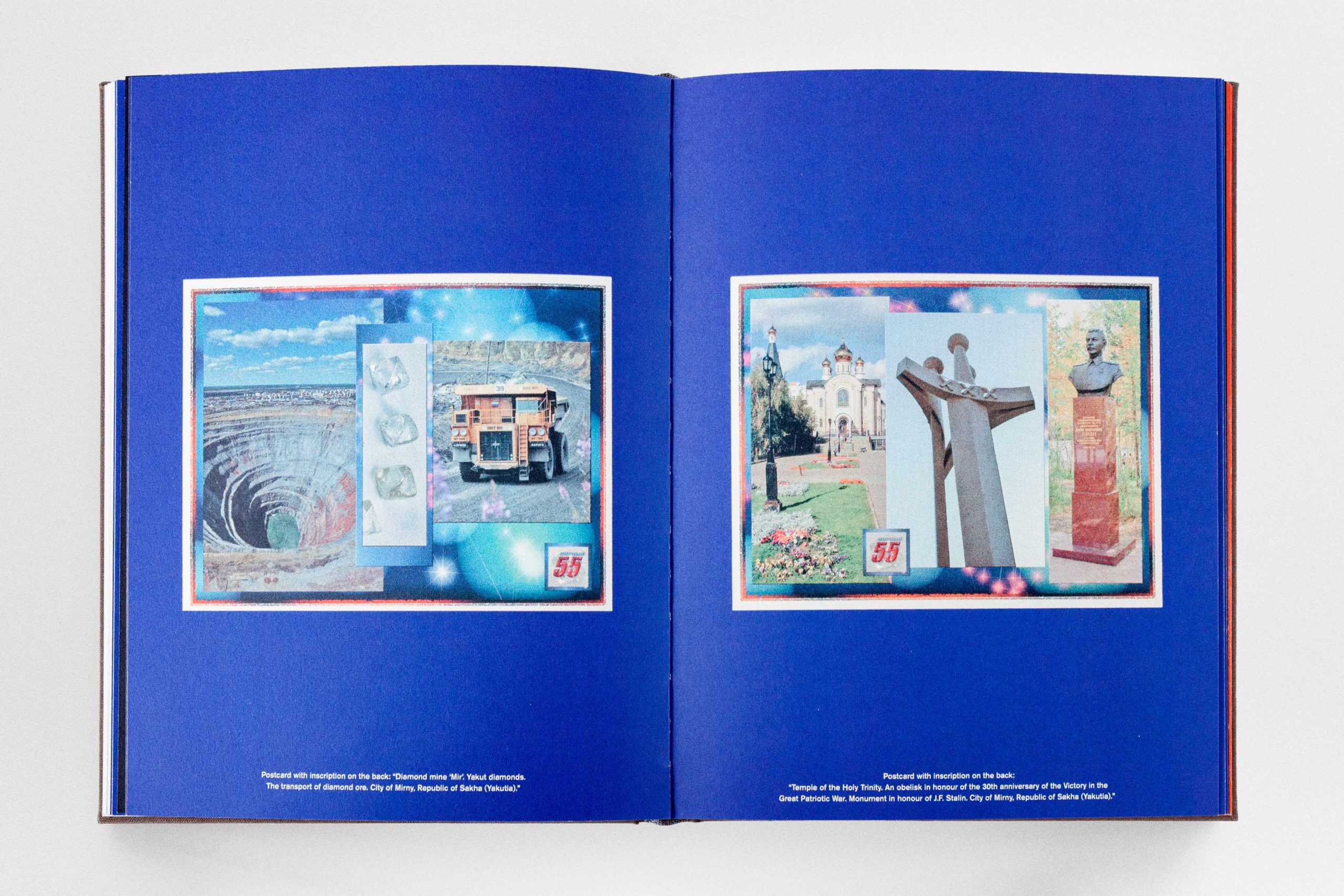
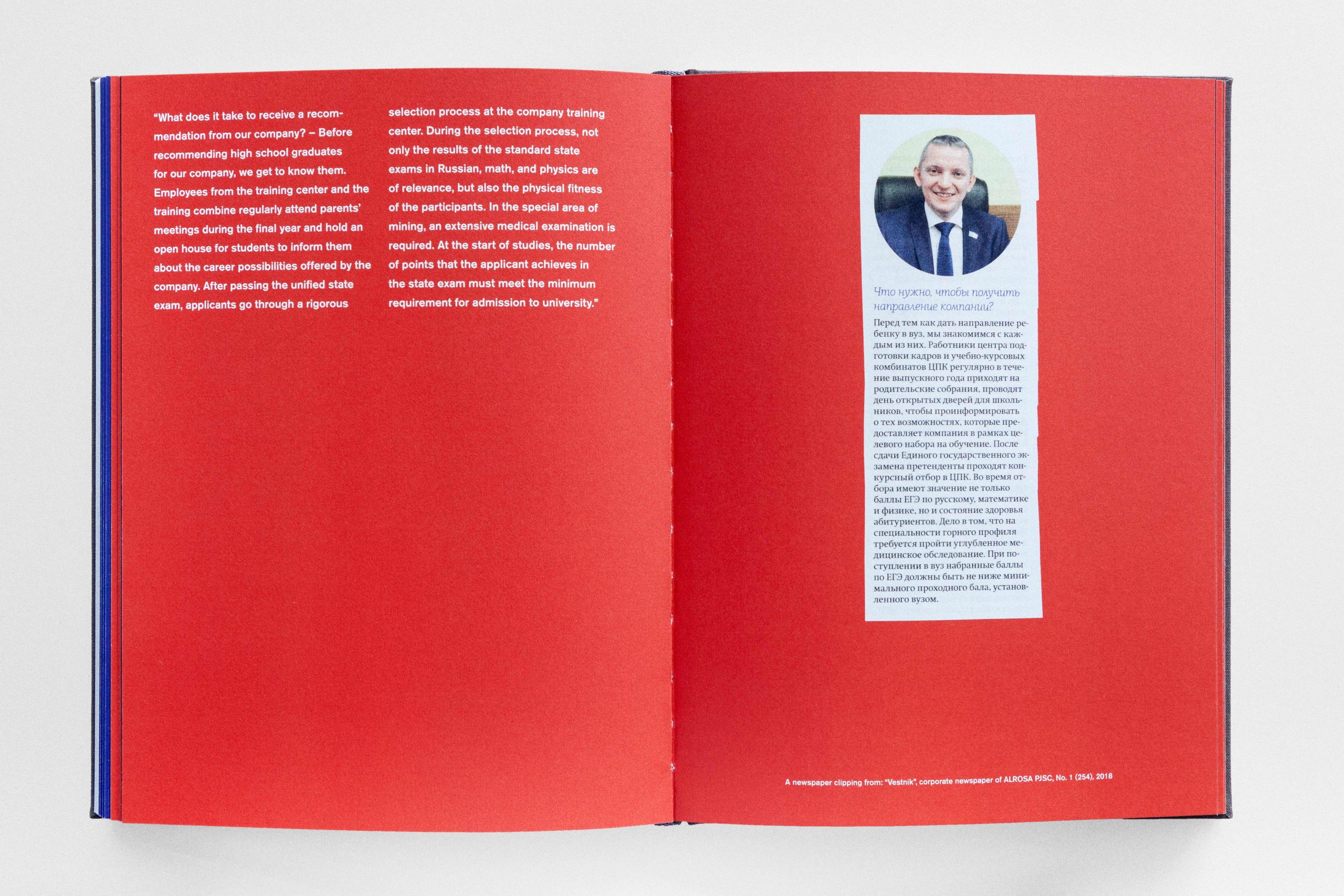
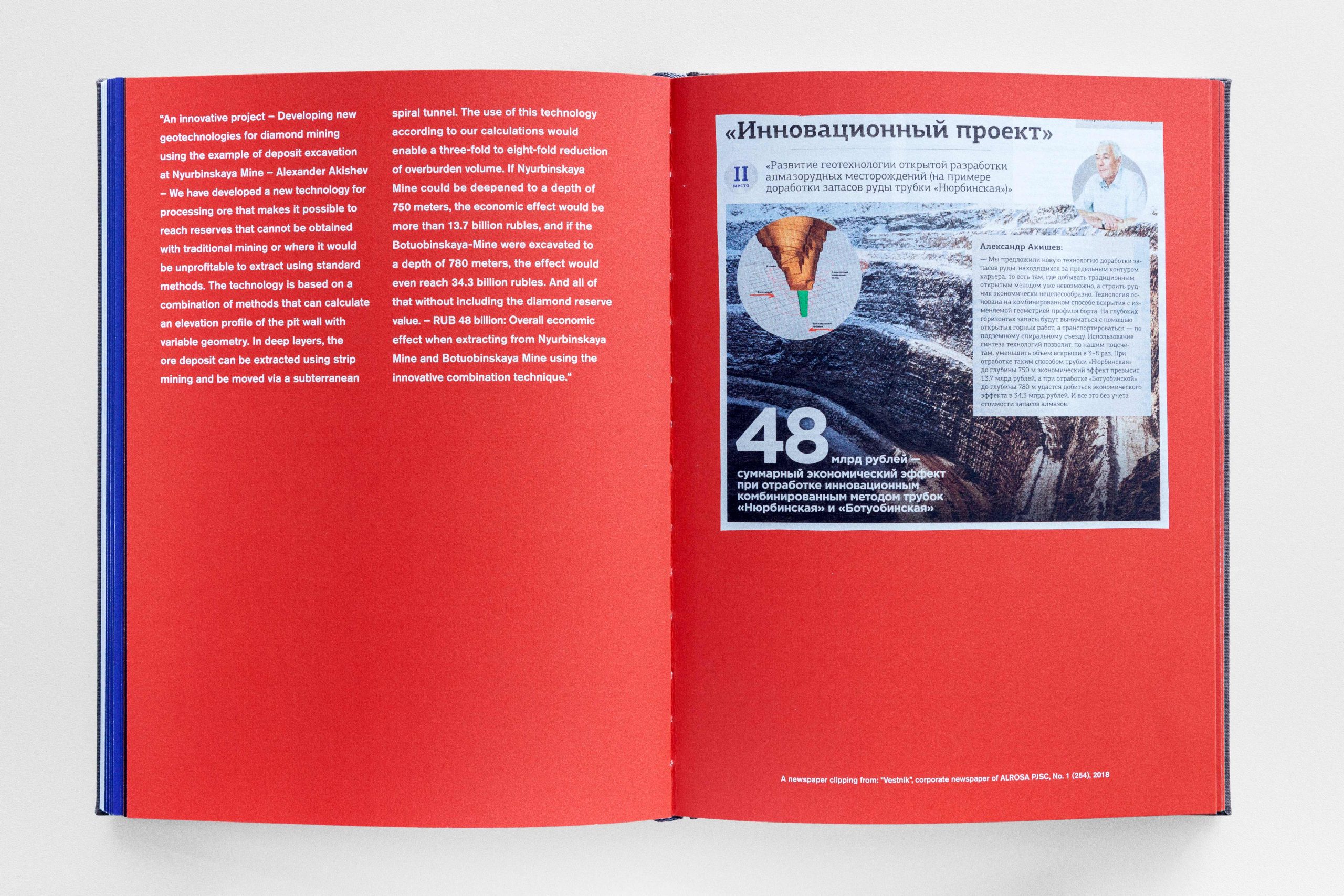
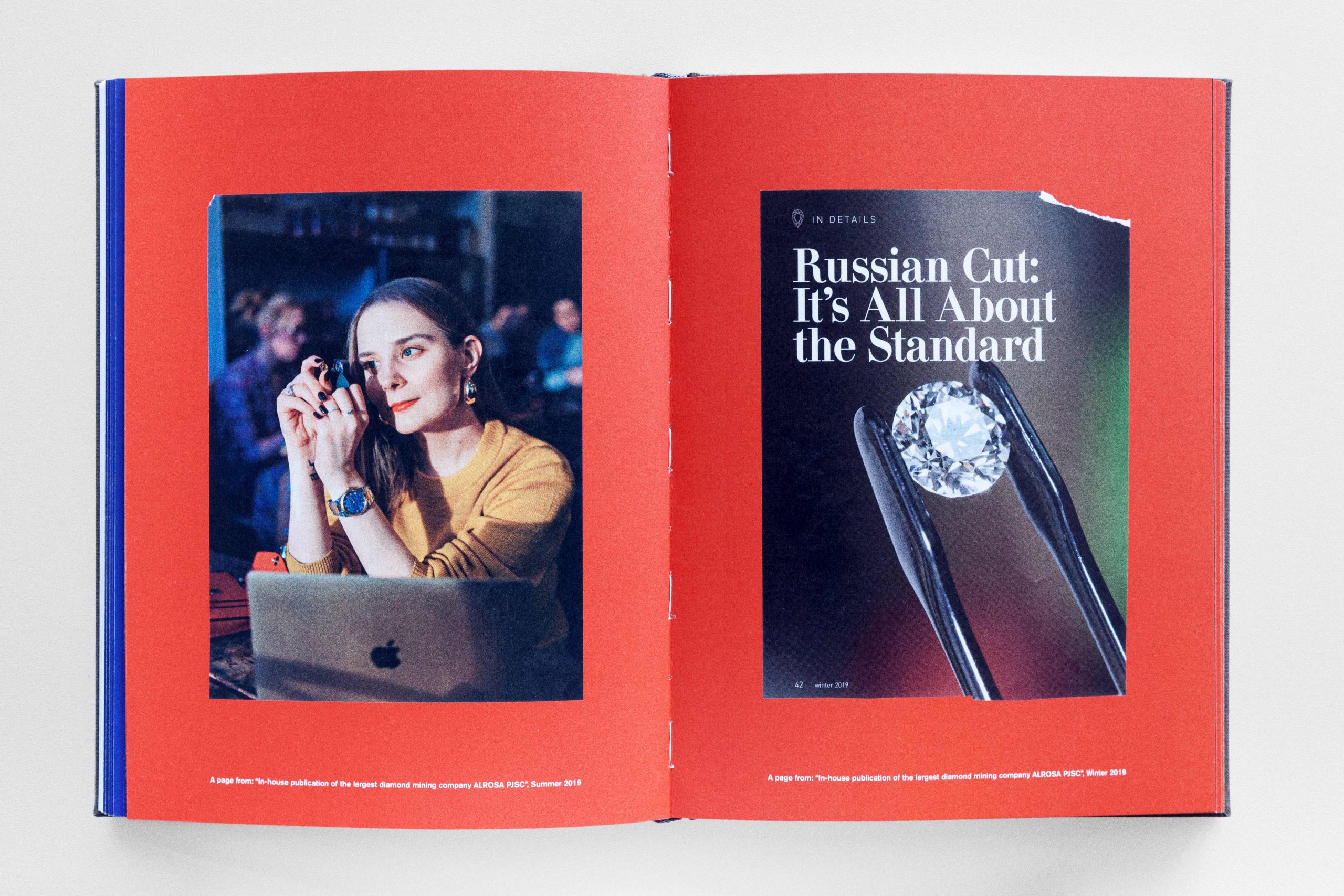
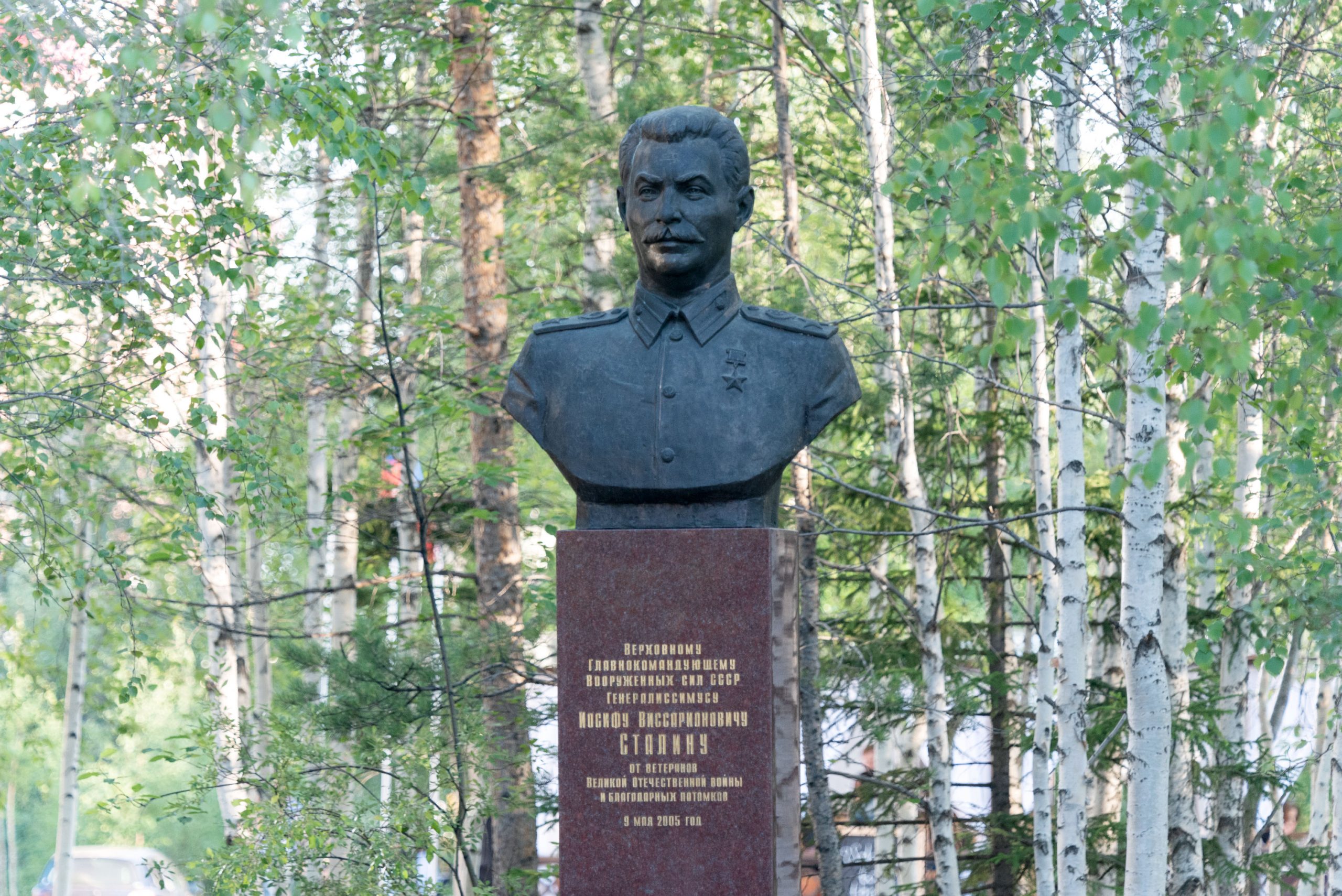
The blue and red chapters of the book reproduce the paper the region issues about itself. In the two ALROSA museums at Mirny the state diamond company narrates its own work: a scale model of the Mir pit, the extraction sequence laid out as a board game from geology to sale, and an oil painting that shows the kimberlite pipe, the rock column that carries the diamonds up from depth, as a funnel through coloured layers of ground. In the company papers the book reproduces, ALROSA’s chief executive reports the year’s results to the president in person and American machines give way to Belarusian ones under an import substitution programme; the company newspaper Vestnik reports a FIFA World Cup sponsorship, and a glossy sister magazine sells the “Russian Cut” beside a holographic Bolshoi ballet. Around these run the smaller papers of belonging: anniversary postcards that still list a monument in honour of J. F. Stalin among the city’s sights, fridge magnets, and the booklets that fix a person to the state, an employment record book printed by Goznak, the state printing works, and a pension certificate of the Russian Pension Fund.

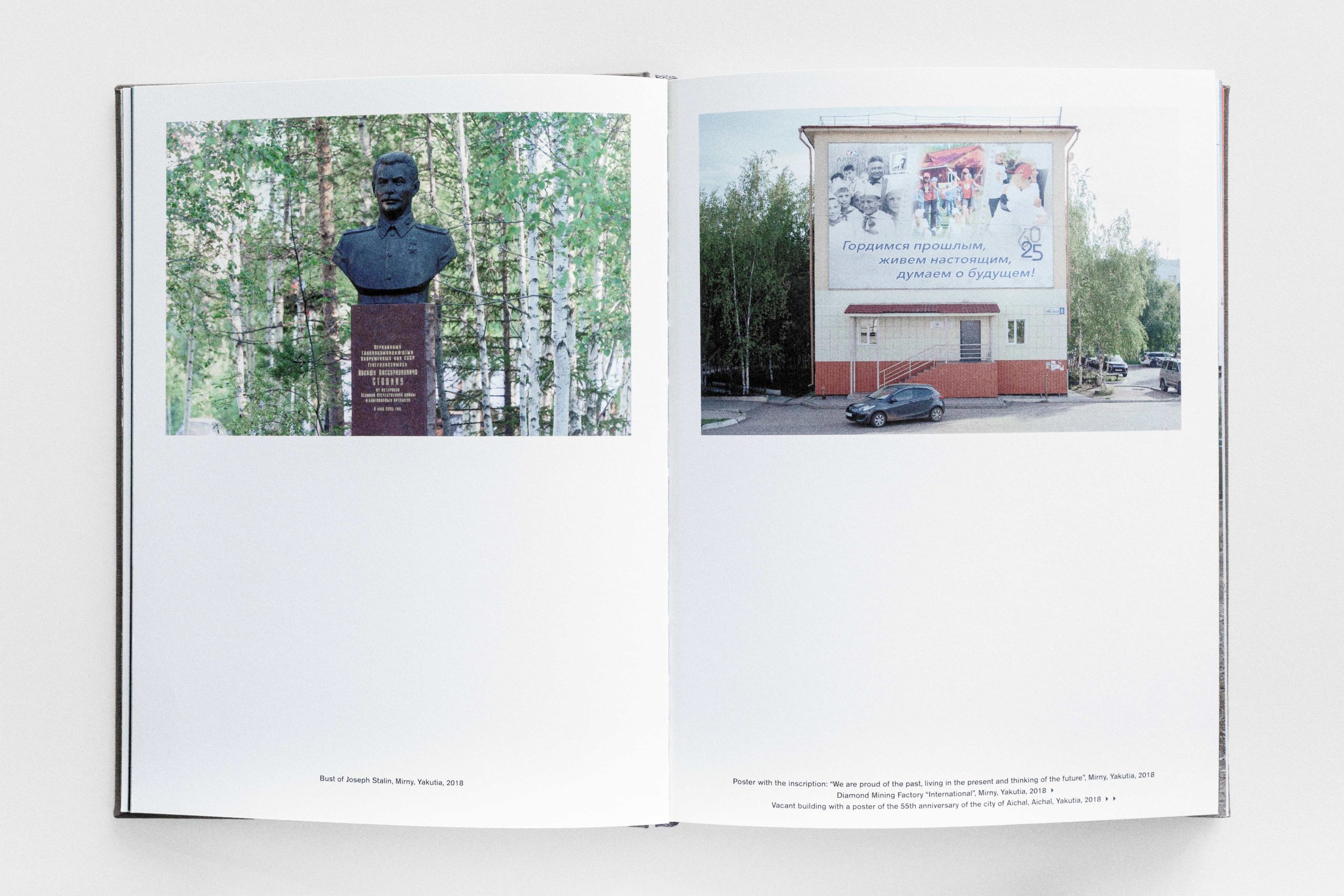
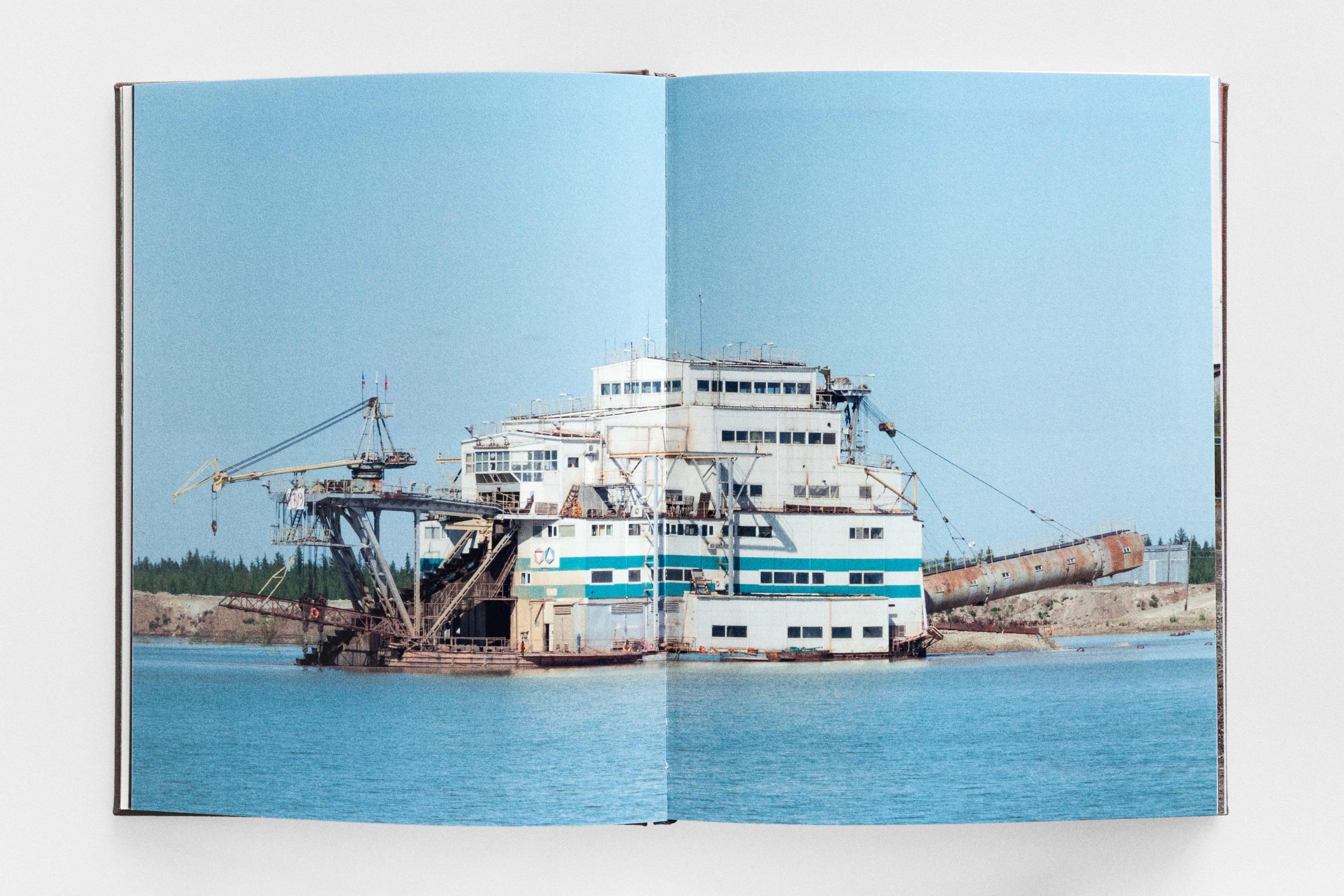
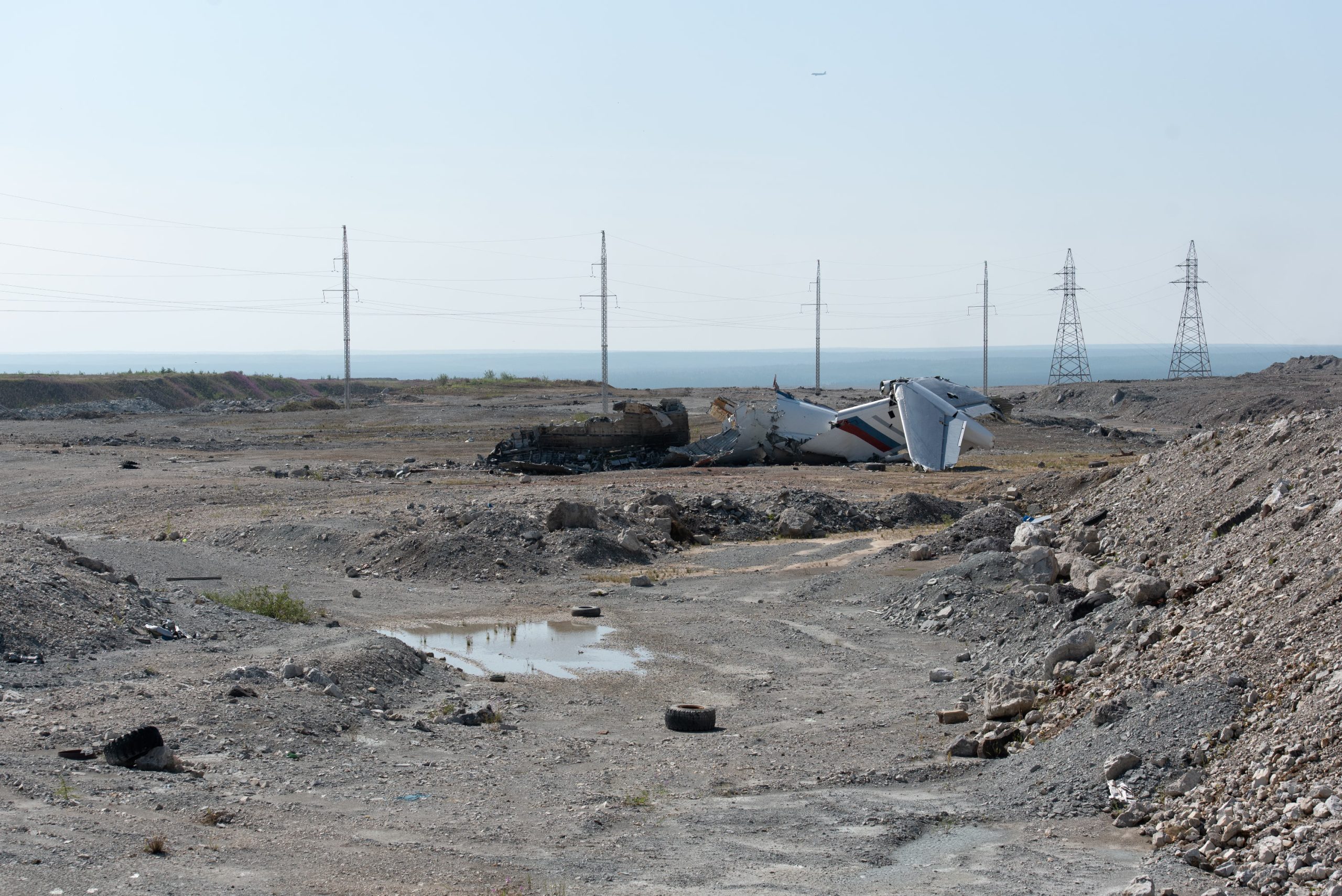
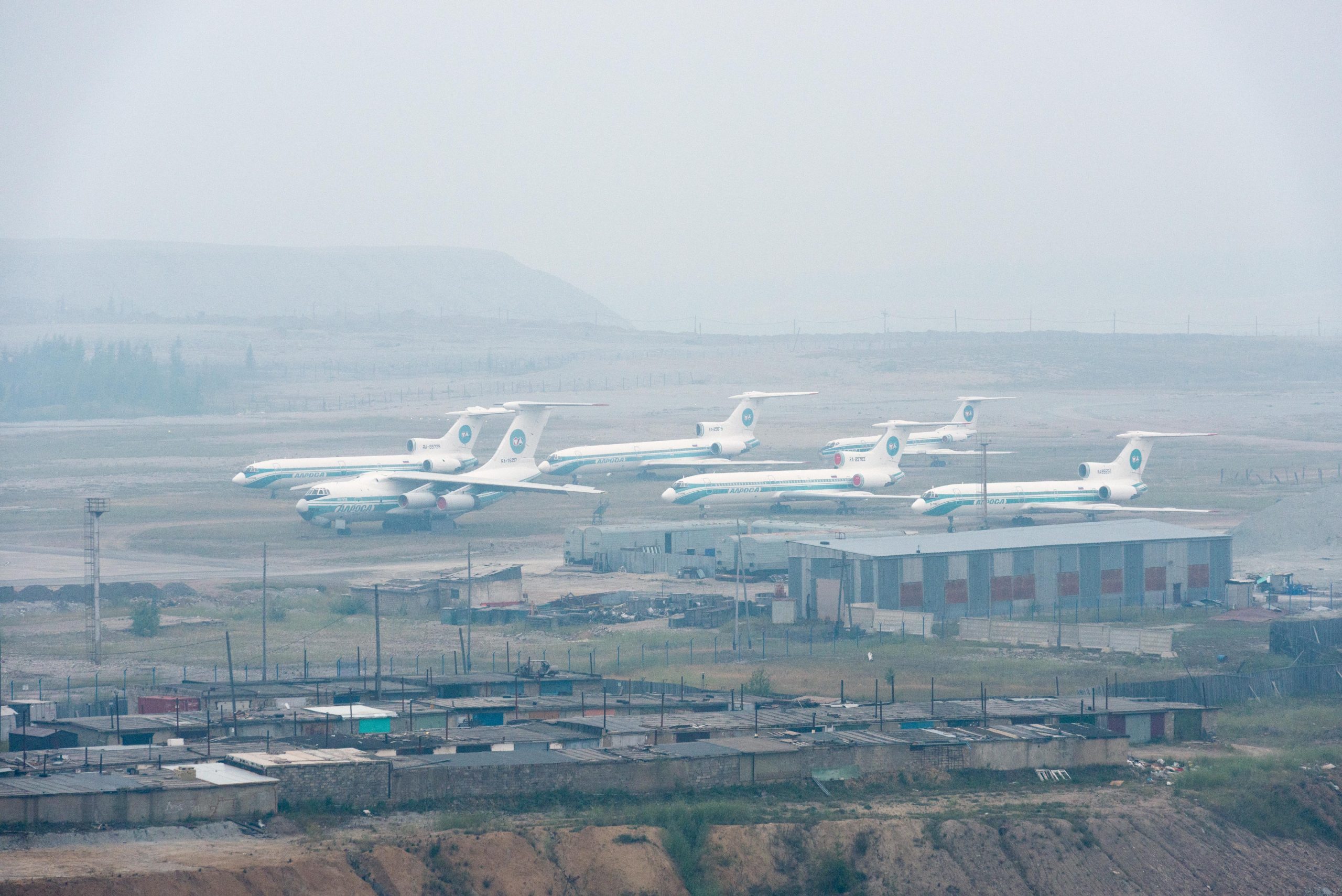
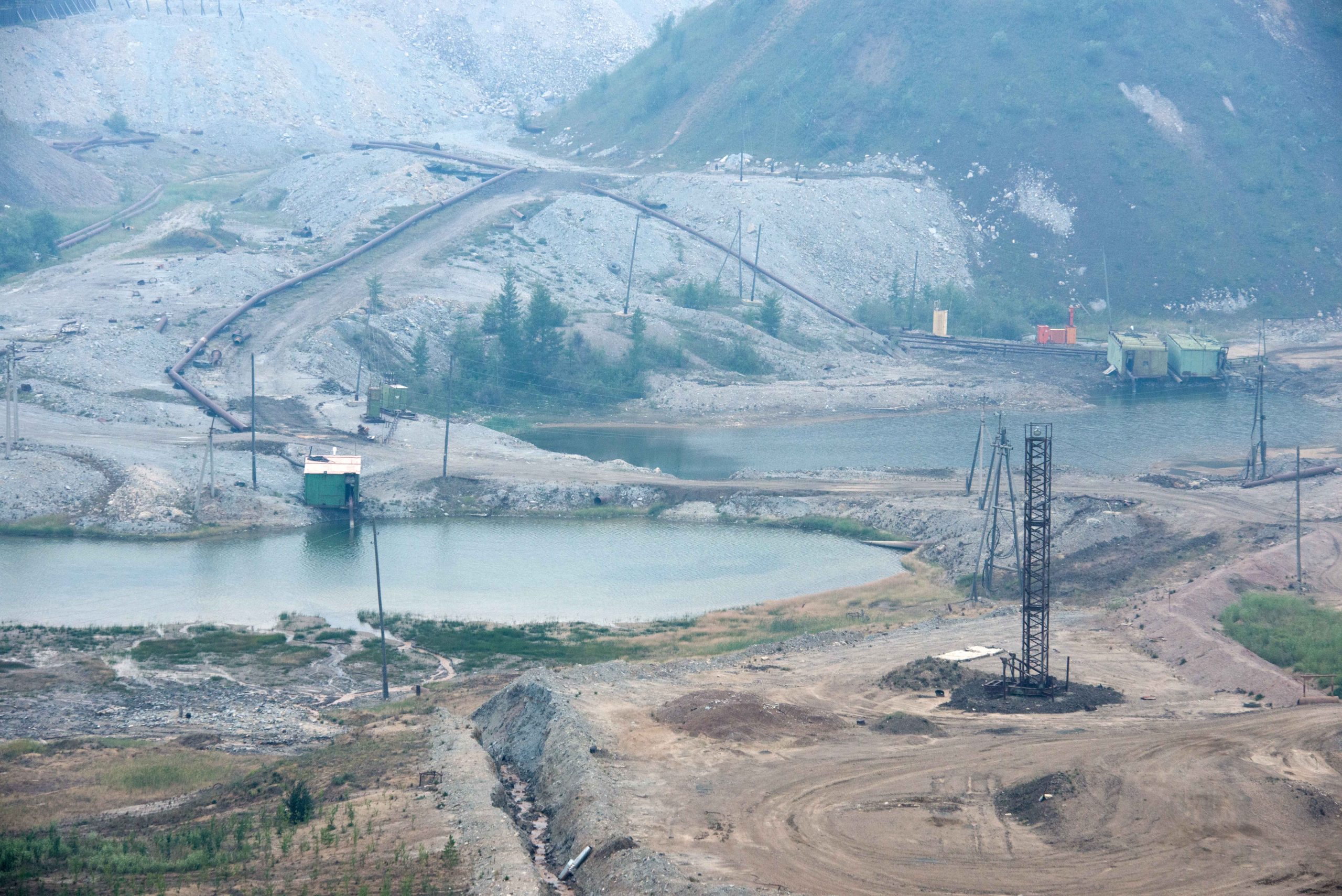
The photographs in the book were made on site in 2018 and are held at a frontal, even distance. At Aykhal a pink concrete hand rises from the taiga, holding a black octahedron, the eight-sided crystal form of a rough diamond, up to the light. The Mir pit is given as a bluish funnel of benched walls narrowing into darkness, the same pit the region models, paints and prints on its magnets elsewhere in the book. A floating dredger, one of the machines that wash diamonds out of river gravel, stands white and rusting on still water at Almazny; a row of aircraft of the diamond company ALROSA waits in industrial haze, and a light aircraft lies wrecked on a waste field. A bust of Stalin keeps its place among the birches of Mirny. Derelict housing blocks at Aykhal are wrapped in glossy tarpaulins for the town’s 55th anniversary, and a banner in Mirny reads: “We are proud of the past, living in the present and thinking of the future.” The monument, the machine and the ruin are held with the same attention as the pit itself.

imperial objects was published in 2020; its colophon lists the book and the film dark matter as the two parts of the site-specific installation imperial machine. Book, film and installation belong to the work the Haus for Media Art Oldenburg, commissioned for Possessed Landscapes (Viktor Brim, Tanja Engelberts, Rachel O’Reilly, Zhou Tao, Zina Saro-Wiwa), 30 January to 29 March 2020, and the book was supported by the Haus for Media Art and by KIT Kunst im Tunnel, Düsseldorf, where it was shown beside the film.

imperial objects