serious apparitions
2017, single-channel video, HD, 22′04″, colour, sound, no dialogue
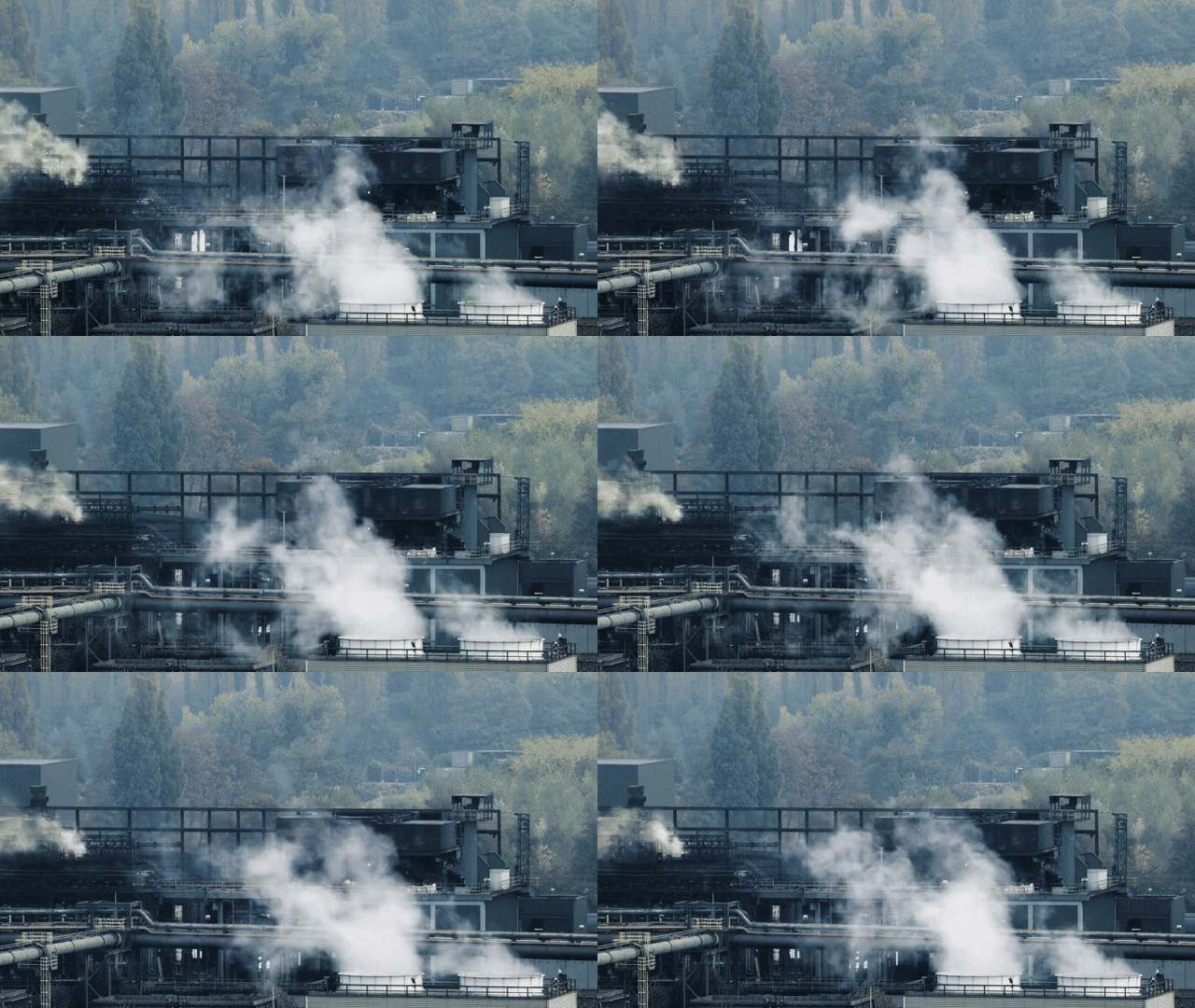
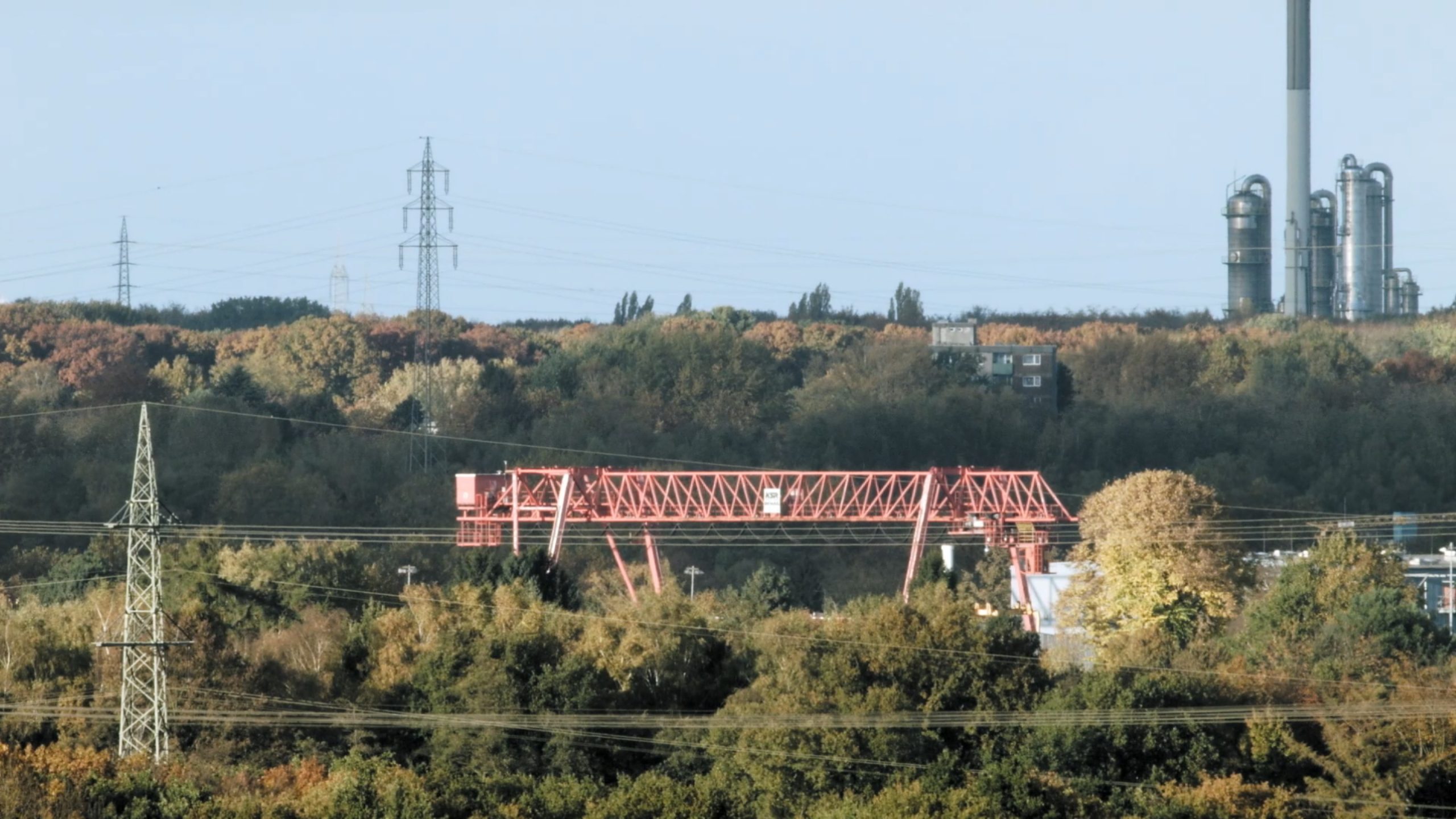
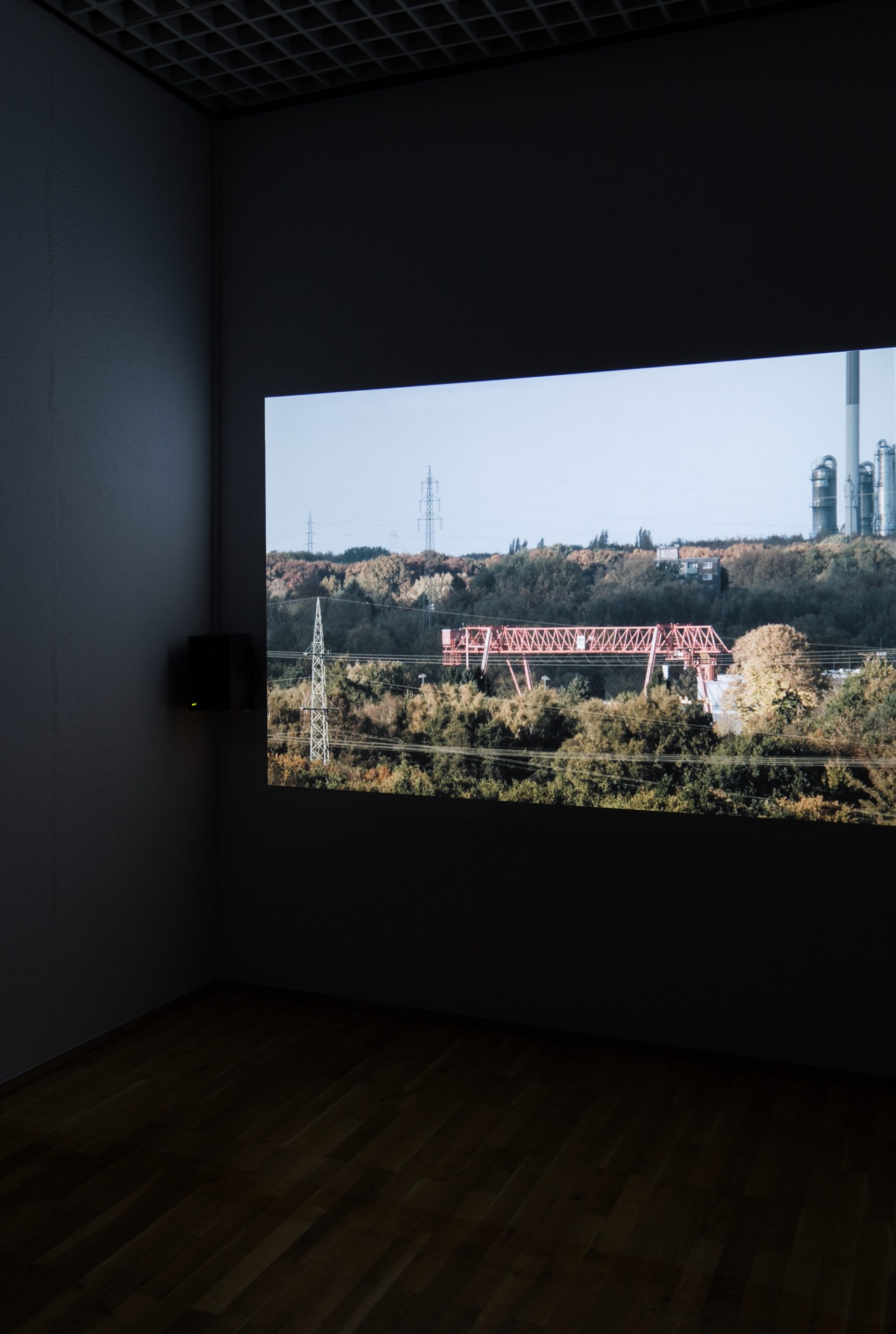
Serious Apparitions looks out over the working industrial landscape of the northern Ruhr from the Tetraeder, a walkable steel pyramid on a spoil heap above Bottrop. Its material is heavy machinery seen from far away. An orange crane trolley slides back and forth. A freight locomotive rolls into a marshalling yard and sets down its wagons. White steam drifts across a fenced-off hilltop where a wind turbine turns. Six tableaus, each composed frontally and held still, wait for the one small movement inside the frame. What comes into view is the time these machines keep: the pace of a process, the interval at which a mechanism returns, the working life of a plant that is still running.
Nadin Mai, written for tao films, on the 2017 single-channel version.
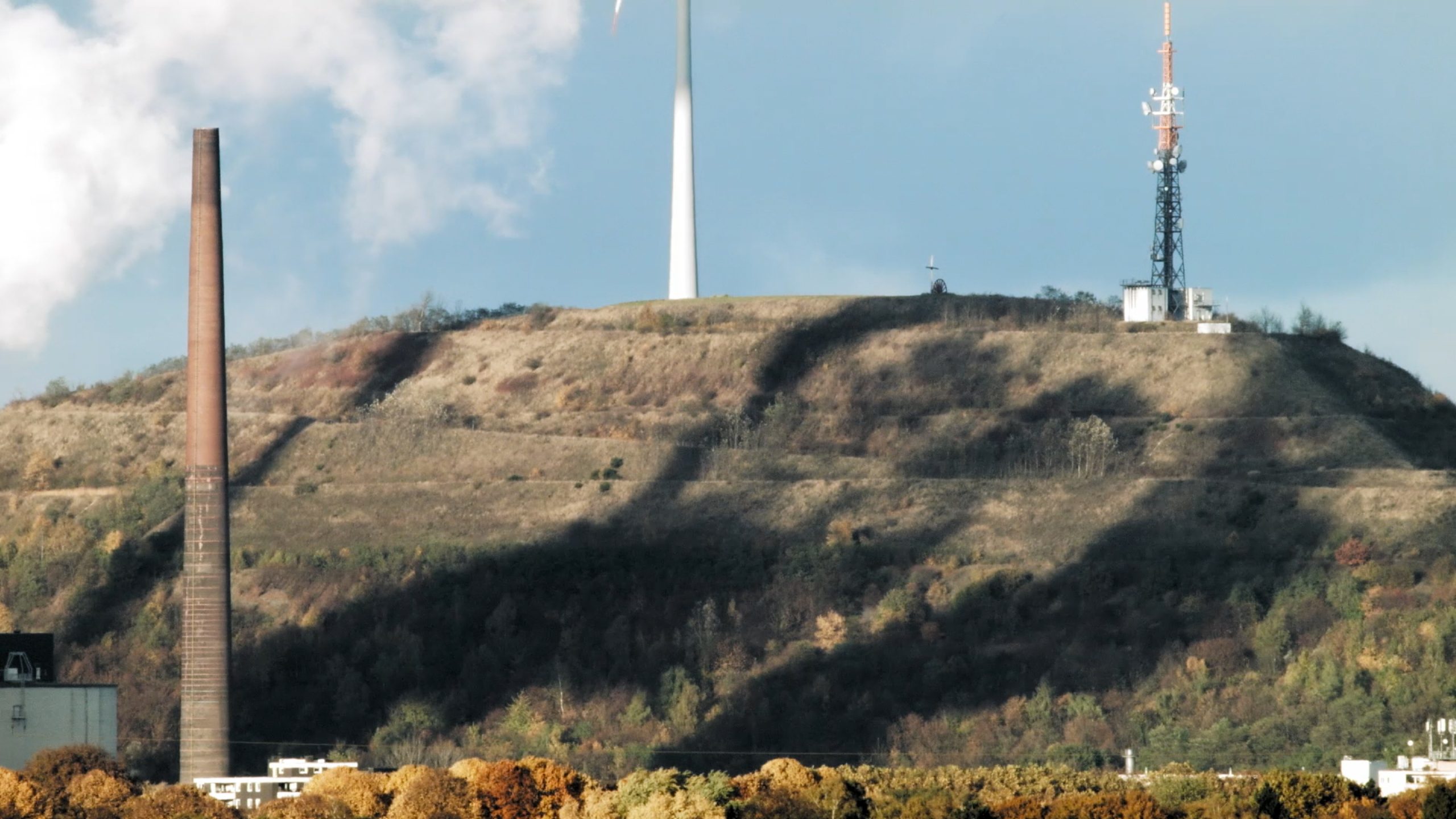
A long shot. In the background, a chimney and a wind turbine on an otherwise deserted hilltop. Smoke appears on the left hand side of the frame. The sunshine that here and there breaks through the clouds of smoke create a fascinating, always changing shadow play on the hilltop. Observing the scenery, director Viktor Brim engages us in a contemplative take on what he himself describes as the “perceptual limits of watching moving images.” Brim visually describes a man-made environment, an industrial world that has shaped our natural environment and in which mechanics take over. And yet, Brim’s aesthetics remind us that regardless of our doings, time remains as it had always been: it creates space, it needs space, and it is time that is the main force in our life.
Seen from a distance, a large machine moves too slowly to look like an event. A crane trolley needs its full run before the movement registers. Steam rises from a plant and bends with the wind, and the shadow it throws travels across the slope of a spoil heap. A freight locomotive takes minutes to set down a single set of wagons. Each of these movements has a fixed rate, set by the process it belongs to: how long a load takes to travel, how long a batch has to be heated, how often a shunting move repeats. Machines, Jussi Parikka argues, do not simply run in time. They produce a time of their own, and these internal rhythms press outward onto the world around them (A Geology of Media, University of Minnesota Press, 2015). Around Bottrop these rhythms belong to ovens, freight yards, power stations and rotors. At this range the northern Ruhr is a landscape of several machine times, running side by side and out of step.
The Kokerei Prosper stands below the heap in Bottrop and has made coke since 1928. Coal is heated in 146 ovens to over 1,000 degrees with the air shut out, which drives off gas and tar and leaves coke behind, the hard porous fuel a blast furnace needs to turn iron ore into iron. Each charge spends about a day in the oven (Route der Industriekultur, Regionalverband Ruhr). The plant works around the clock on every day of the year, and the coke leaves by rail for the blast furnaces of its owner in Bremen (ArcelorMittal Germany). Its machine time is this interval, repeated without a pause. The three batteries are built for close to two million tonnes a year and currently produce around 1.2 million. The coal itself no longer comes from below: the mine that supplied it closed at the end of 2018, and the ovens have run on bought coal since.
The Kraftwerk Scholven stands in Gelsenkirchen, north-east of Bottrop, and was the largest hard-coal power station in Germany in the 1960s (Uniper). Three of its blocks were shut down in 2014, a gas unit came online in 2024, one cooling tower was brought down by explosives in September 2025 and two more, 114 metres high and some 15,000 tonnes of concrete, in May 2026. A hydrogen-ready gas plant is planned on the cleared ground, and two coal-fired blocks stay on the grid as a reserve until 2031 (Uniper). Above the station rises the Halde Oberscholven, a terraced heap raised between 1966 and 1987 from the waste rock of three collieries and, at around 201 metres above sea level, the highest artificial hill in the Ruhr. It is fenced, still under mining supervision, and passed into the hands of the Regionalverband Ruhr in January 2026. Two turbines have stood on its plateau since 2010. Three times run side by side up there: the rotor in seconds, the steam in minutes, the shadow at the pace of the clouds.
Hard coal was cut in the Ruhr for about a hundred and fifty years and stopped in 2018. At the peak in 1957 around 500,000 people worked in the mines of the region; by 2016 there were about 4,500 (Umweltbundesamt, Climate Change 29/2021). Around thirty coking plants ran here into the 1960s and three still operate. Prosper-Haniel in Bottrop, the last hard-coal mine in Germany, closed in December 2018, and in October 2021 the filling of its shafts began. What ended is the cutting, not the burning. The ovens and the remaining coal blocks are supplied from the world market, by ship into the North Sea ports and inland by barge and rail. The plants stand where the seams were, and the material now arrives from coalfields elsewhere.